
 |
| 1000cc 120° |
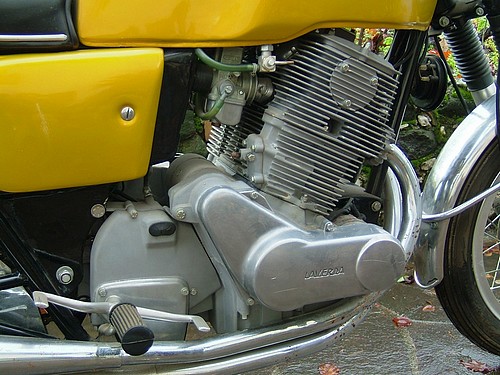
| Note to the reader: The information given below concerns the various types of Laverda 1000 and 1200 as a whole. The factory did, however, occasionally but fairly regularly use different parts within a single series, notably depending on supply uncertainties from subcontractors. It is therefore not unusual for bikes from a later series to have been fitted with engine or chassis parts from an earlier series, or for two bikes from the same series to differ slightly — this being in no way proof that a model is not original. Photos subject to copyright (Laverda factory, Laverda family, G. Sperotto, JL Olive; reproduction forbidden without permission of the rights holders) Part 3: The 1000cc 120° from 1982 to 1989 The Jota 120: Pressed by ever more restrictive noise regulations, facing customers increasingly focused on the standards set by the Japanese bikes, and forced to deal with an ageing big-capacity model despite its performance and its successful 1981 redesign, the Laverda factory had to plan a new top-of-the-range model to replace its triple. The problem was that this required investment at the very moment when the factory's finances were in a critical situation, notably following the technical incidents of 1979 and the sunk investments in the 1000 V6 project (stopped in mid-development because of the change in FIM regulations) and the 4×4 vehicle in response to the Italian government's tender. This period also coincided with the retirement of Technical Director Luciano Zen, a pillar of the company since the very beginning in 1947 and creator of all the marque's legendary models. The factory then recruited Giuseppe Bocchi, an engineer who had worked notably for MV Agusta's racing department, and who arrived with new ideas resolutely geared to the motorcycle trends of the early 1980s — but out of reach of the company's finances… Massimo Laverda therefore imposed a specification based on an extrapolation of the 1000cc triple engine, so as to make it more in keeping with the fashion of the moment, which preferred smooth running to outright performance. In order to make this engine less brutal, Bocchi reconsidered the triple's classic 120° timing. Of course, the balancing constraints remained unchanged, the engine being unable to accept the addition of a balancer system without a deep redesign. The work therefore consisted of taking the broad outlines of the 1981 Jota (left-side ignition, 250W alternator, new gearbox with left-side shift, new clutch, new cylinder head) and giving it a crankshaft timed at 120°, the fight against vibration being entrusted to silent-blocks fitted between the engine and the frame, as well as to special crankshaft bearings. It was thus an intermediate solution, unfortunately dictated by economy, but which proved broadly satisfactory since reliability was not found wanting over time. At the same time new camshafts (christened F1) were fitted, although some of these new machines were equipped with 4C cams, or very rarely A11 profiles. The power of the 120° engine was strictly identical to that of the base 180° engine, i.e. 80 hp. While awaiting the styling completion of the new 1000, which was under way, the factory decided to install the new 120° engine in a machine very close to the 180° Jota of 1981. The bodywork, the frame, the wheels — everything was almost identical to the Jota 180, except that the engine was mounted in the frame via large silent-blocks. This bike was called the "Jota 120", a nickname that was not undeserved so much did it resemble the 1981 Jota 180; 400 were produced. The new engine radically changed the Jota's behaviour and character: everything was different, it was unquestionably more docile, more versatile, more linear, the vibrations were different (more in the form of a tingling), in short more in line with the Japanese standards of the 1980s. As a result, the 120 engine attracted as many new customers used to the usual contemporary products as it repelled the fans of the original Jota 180, for whom sportiness and character were the very identity of the marque… Thirty years later, the debate is still open! But the Jota 120 was also the subject of criticism for its road manners, a new thing for a Laverda. Since its engine was rubber-mounted, it no longer contributed to the frame's rigidity, which created some weaving in high-speed corners.  The Jota 120, very close to the 1981 Jota 180 apart from the engine timing. This photo shows the pre-production model; the definitive one would carry a "Jota 120" badge. The Jota 120, very close to the 1981 Jota 180 apart from the engine timing. This photo shows the pre-production model; the definitive one would carry a "Jota 120" badge.  The engine is mounted in the frame via large silent-blocks. By the time the Jota 120 was being distributed, the styling study of the new Laverda 1000 was almost complete. If the engine could not be fundamentally new, the factory wanted the machine's overall style to be avant-garde and out of step with the competition. The study was entrusted to a Roman styling office, RG Studio, which had already designed the Morini 500 turbo project. The aim was to design a particularly aerodynamic machine without tarnishing the marque's identity, which was no easy thing given that the look of the Laverda 1000 had been fixed in people's minds for more than ten years. RG Studio nonetheless pulled off this feat with a rather avant-garde and singular "bio" design, which nevertheless left no doubt about the Breganze origin of the mechanicals. The engine is mounted in the frame via large silent-blocks. By the time the Jota 120 was being distributed, the styling study of the new Laverda 1000 was almost complete. If the engine could not be fundamentally new, the factory wanted the machine's overall style to be avant-garde and out of step with the competition. The study was entrusted to a Roman styling office, RG Studio, which had already designed the Morini 500 turbo project. The aim was to design a particularly aerodynamic machine without tarnishing the marque's identity, which was no easy thing given that the look of the Laverda 1000 had been fixed in people's minds for more than ten years. RG Studio nonetheless pulled off this feat with a rather avant-garde and singular "bio" design, which nevertheless left no doubt about the Breganze origin of the mechanicals.The bike also boldly incorporated a few elements clearly inspired by automotive production, such as the dashboard, or a pivoting flap in the fairing for refuelling… The bodywork was built in a special deformation-resistant composite material called Bayflex, again used by certain car manufacturers.  The penultimate RGS prototype. The kinship with the Morini turbo is even more obvious than on the definitive model. Here again, the RGS (which borrowed the styling office's initials) caused debate among Laverdisti, creating a mix of pleasure at seeing a new model arrive — with an original design and a very good level of finish to boot — and at the same time divided feelings about the marque's new image, which deliberately set aside the "hardcore" motorcycle status for a distinctly more refined atmosphere… But at least one aspect helped the RGS's launch: the bike was comfortable and particularly at ease on long journeys, including motorways. On that front, Laverda won its bet by managing to completely soften its triple, going from a sporting and exclusive bike to a comfortable touring one while keeping the same engine basis. The engine remained strictly that of the Jota 120 with F1 camshafts as standard. The suspension was new, with longer fork tubes (still Marzocchi 38) and remote-reservoir rear shocks. The frame was entirely new to compensate for the Jota 120's weaknesses, notably with a considerably reinforced backbone made of three adjoining tubes. Despite this, the frame was not free of some cracking problems around the steering head, which prompted the factory to plan a weld-on reinforcement kit a little later. The exhaust system aimed to meet the norms of the time, i.e. very muffled but nonetheless effective. One of the RGS's major weak points was its lighting, the car-derived headlight (Fiat 127) being insufficient, contrasting with the machine's high overall level of finish. The penultimate RGS prototype. The kinship with the Morini turbo is even more obvious than on the definitive model. Here again, the RGS (which borrowed the styling office's initials) caused debate among Laverdisti, creating a mix of pleasure at seeing a new model arrive — with an original design and a very good level of finish to boot — and at the same time divided feelings about the marque's new image, which deliberately set aside the "hardcore" motorcycle status for a distinctly more refined atmosphere… But at least one aspect helped the RGS's launch: the bike was comfortable and particularly at ease on long journeys, including motorways. On that front, Laverda won its bet by managing to completely soften its triple, going from a sporting and exclusive bike to a comfortable touring one while keeping the same engine basis. The engine remained strictly that of the Jota 120 with F1 camshafts as standard. The suspension was new, with longer fork tubes (still Marzocchi 38) and remote-reservoir rear shocks. The frame was entirely new to compensate for the Jota 120's weaknesses, notably with a considerably reinforced backbone made of three adjoining tubes. Despite this, the frame was not free of some cracking problems around the steering head, which prompted the factory to plan a weld-on reinforcement kit a little later. The exhaust system aimed to meet the norms of the time, i.e. very muffled but nonetheless effective. One of the RGS's major weak points was its lighting, the car-derived headlight (Fiat 127) being insufficient, contrasting with the machine's high overall level of finish.  The RGS in pre-production form. The mirrors and wheels would be different on the definitive version. The RGS in pre-production form. The mirrors and wheels would be different on the definitive version.  The RGS in its definitive version. The RGS certainly had the appeal of its originality and its level of finish, but it remained expensive. From 1983 the factory therefore offered a stripped-down version, called the RGA, without the fairing (a simple fork-top fairing was fitted) and with a classic tank with a filler on top. While the resulting price cut did not really boost sales, some importers cleverly fitted the RGA with special equipment, such as the RGA Jota or above all the RGA Sprint, fitted with a very pretty twin-headlight fairing. These special formulas made it possible to acquire a desirable machine at a lower price than the RGS. The RGS in its definitive version. The RGS certainly had the appeal of its originality and its level of finish, but it remained expensive. From 1983 the factory therefore offered a stripped-down version, called the RGA, without the fairing (a simple fork-top fairing was fitted) and with a classic tank with a filler on top. While the resulting price cut did not really boost sales, some importers cleverly fitted the RGA with special equipment, such as the RGA Jota or above all the RGA Sprint, fitted with a very pretty twin-headlight fairing. These special formulas made it possible to acquire a desirable machine at a lower price than the RGS.  The RGA, the economy version of the RGS. The RGA, the economy version of the RGS.  The RGA Sprint with its elegant twin-headlight fairing. In 1984, taking advantage of a special order from the Syrian government (under an inter-governmental agreement) for 100 machines based on the RGS, intended for the police forces, the factory brought out a civilian version of this particular model. Named "Executive" and equipped like a genuine grand-touring bike with hard panniers, raised clip-ons and extra protection on the fairing, it was mainly sold in North America and Australia. Apart from this equipment, the bike is a normal RGS, and it was therefore not unusual for these specific Executive fittings to be mounted on standard RGSs. The addition of an identifying sticker on the frame by the US importer of the time adds to the confusion, and the precise number of Executives produced at the factory remains unknown. The RGA Sprint with its elegant twin-headlight fairing. In 1984, taking advantage of a special order from the Syrian government (under an inter-governmental agreement) for 100 machines based on the RGS, intended for the police forces, the factory brought out a civilian version of this particular model. Named "Executive" and equipped like a genuine grand-touring bike with hard panniers, raised clip-ons and extra protection on the fairing, it was mainly sold in North America and Australia. Apart from this equipment, the bike is a normal RGS, and it was therefore not unusual for these specific Executive fittings to be mounted on standard RGSs. The addition of an identifying sticker on the frame by the US importer of the time adds to the confusion, and the precise number of Executives produced at the factory remains unknown.  The RGS Executive, a civilian version derived from a Syrian government order. Shortly afterwards, keen to offer a sharper version, the factory brought out the RGS Corsa. Very close in outward appearance to the standard RGS, its engine nonetheless benefited from noticeable improvements, similar to the developments the Jota had received from 1976: high-compression pistons, big valves (40.5/34.5) and reworked intake ports gave it 95 hp. Braking was also improved thanks to floating front discs, still 280mm in diameter. The RGS Executive, a civilian version derived from a Syrian government order. Shortly afterwards, keen to offer a sharper version, the factory brought out the RGS Corsa. Very close in outward appearance to the standard RGS, its engine nonetheless benefited from noticeable improvements, similar to the developments the Jota had received from 1976: high-compression pistons, big valves (40.5/34.5) and reworked intake ports gave it 95 hp. Braking was also improved thanks to floating front discs, still 280mm in diameter.  The RGS Corsa, the sporting version of the RGS, with a very convincing engine. In parallel Laverda brought out a competition version based on the RGS. Far more than an extrapolation of the Corsa, it was a machine most of whose parts were new, with almost everything reworked in the engine and chassis. This machine used special camshafts christened P1, which were later offered as an option for the road bikes. Entered in TTF1 events, this bike achieved honourable results in the hands of riders such as V. Ferrari and R. Balbi in Italy, Martin Hone in Australia and Jean-Pierre Haemish in France, despite a weight that was still too high and an architecture not favouring agility. The RGS Corsa, the sporting version of the RGS, with a very convincing engine. In parallel Laverda brought out a competition version based on the RGS. Far more than an extrapolation of the Corsa, it was a machine most of whose parts were new, with almost everything reworked in the engine and chassis. This machine used special camshafts christened P1, which were later offered as an option for the road bikes. Entered in TTF1 events, this bike achieved honourable results in the hands of riders such as V. Ferrari and R. Balbi in Italy, Martin Hone in Australia and Jean-Pierre Haemish in France, despite a weight that was still too high and an architecture not favouring agility.  Romolo Balbi and his RGS TT1 at Misano, awaiting scrutineering. Romolo Balbi and his RGS TT1 at Misano, awaiting scrutineering.  Two spare TT1 engines. In 1985, as Massimo Laverda had to leave the company for health reasons, the ultimate version of the Laverda 1000 triple appeared, the SFC 1000. Inspired and wanted by the German importer, it was designed mostly in Germany. The principle was to design an extrapolation of the Corsa for more sporting use. The goal was therefore to remove superfluous comfort equipment or that which was too grand-touring in character, to fit more radical suspension and brakes, to replace the costly and hard-to-repair Bayflex with fibreglass, and to fit lighter wheels. This led to the removal of the large footrest plates in favour of sport-style rearsets, a 41.7mm Marzocchi M1R front fork, two 300mm floating Brembo front discs and gold-series Brembo calipers, a box-section aluminium swingarm, OSCAM alloy wheels with a slightly wider rear tyre (130 instead of 120), and a polyester bodywork set (except the steel tank), the rear part of which is a monocoque. The overall design of this bodywork was revised to better match the machine's sporting character, and the tank is now filled via a classic knurled aluminium cap (an identical second cap serving as a breather). The large car-type instrument of the RGS and Corsa gave way to a sport set with a white-faced Veglia clock, whose rev counter is mechanically driven (as a result of which the cam cover differs from the RGS). The engine remains strictly identical to that of the Corsa, thus with 95 hp, which could be raised to almost 100 hp thanks to an optional "sport" kit including a Termignoni 3-into-1 exhaust (which favours power at the expense of mid-range torque), P1 camshafts and different carburation settings. Two spare TT1 engines. In 1985, as Massimo Laverda had to leave the company for health reasons, the ultimate version of the Laverda 1000 triple appeared, the SFC 1000. Inspired and wanted by the German importer, it was designed mostly in Germany. The principle was to design an extrapolation of the Corsa for more sporting use. The goal was therefore to remove superfluous comfort equipment or that which was too grand-touring in character, to fit more radical suspension and brakes, to replace the costly and hard-to-repair Bayflex with fibreglass, and to fit lighter wheels. This led to the removal of the large footrest plates in favour of sport-style rearsets, a 41.7mm Marzocchi M1R front fork, two 300mm floating Brembo front discs and gold-series Brembo calipers, a box-section aluminium swingarm, OSCAM alloy wheels with a slightly wider rear tyre (130 instead of 120), and a polyester bodywork set (except the steel tank), the rear part of which is a monocoque. The overall design of this bodywork was revised to better match the machine's sporting character, and the tank is now filled via a classic knurled aluminium cap (an identical second cap serving as a breather). The large car-type instrument of the RGS and Corsa gave way to a sport set with a white-faced Veglia clock, whose rev counter is mechanically driven (as a result of which the cam cover differs from the RGS). The engine remains strictly identical to that of the Corsa, thus with 95 hp, which could be raised to almost 100 hp thanks to an optional "sport" kit including a Termignoni 3-into-1 exhaust (which favours power at the expense of mid-range torque), P1 camshafts and different carburation settings.  The SFC 1000 prototype, photographed in Germany in 1985. The 16″ front wheel and the special exhaust would not be carried over to the definitive model. The SFC 1000 prototype, photographed in Germany in 1985. The 16″ front wheel and the special exhaust would not be carried over to the definitive model.  The definitive version of the SFC 1000. The definitive version of the SFC 1000.  The cockpit with its specific dashboard. The SFC 1000 would be produced until 1988 (the last models being marketed at the beginning of 1989) and would be the last Laverda triple ever produced. The cockpit with its specific dashboard. The SFC 1000 would be produced until 1988 (the last models being marketed at the beginning of 1989) and would be the last Laverda triple ever produced.In 1987 the German importer, again, created a special version of the SFC 1000, called the SFC 1000 Classic, offered in black (a few last models from late 1988 were offered in red, but these were exceptions) and with spoked wheels.  The SFC 1000 Classic with its spoked wheels and black livery. The SFC 1000 would be a model without major worries, but it would suffer the vagaries of the end of Laverda factory production, then in great financial difficulty. The SFC 1000 Classic with its spoked wheels and black livery. The SFC 1000 would be a model without major worries, but it would suffer the vagaries of the end of Laverda factory production, then in great financial difficulty.The rear shell tended to crack at first, and the factory changed the shape of the shell to make it more resistant.  The old rear shell on the left, the new (reinforced) one on the right. Moreover, at the end of 1988, when the factory had no stock left and was finishing assembling a few examples for final customers, and when suppliers were reporting stock shortages, some 4 to 5 SFC 1000s were fitted with Jota 120- and RGA-type instrument clusters in place of the Veglia clocks. The old rear shell on the left, the new (reinforced) one on the right. Moreover, at the end of 1988, when the factory had no stock left and was finishing assembling a few examples for final customers, and when suppliers were reporting stock shortages, some 4 to 5 SFC 1000s were fitted with Jota 120- and RGA-type instrument clusters in place of the Veglia clocks.  Special and exceptional fitting of a Jota 120 instrument cluster on a few last SFC 1000s owing to stock shortages. The factory was then living its final hours, and the very last SFC 1000s were thus laboriously completed. A number of them were never used, left crated for pure collection purposes, some considering the SFC 1000 to be the last true superbike of motorcycling's golden age. Special and exceptional fitting of a Jota 120 instrument cluster on a few last SFC 1000s owing to stock shortages. The factory was then living its final hours, and the very last SFC 1000s were thus laboriously completed. A number of them were never used, left crated for pure collection purposes, some considering the SFC 1000 to be the last true superbike of motorcycling's golden age.  |
Production of the 1000 120°: Year — Production (official factory data, 19 June 1991) — Production (Laverdamania est.) — Notes. 1982 Jota 120 200 / 400. 1982 RGS 80 / 560. 1983 620 / 650. 1984 590 / 550 + 80 to 100 outside normal numbering. 1985 370 / 260. 1986 300 / 220. 1987 230 / 200. 1988/89 60 / 110. Total 2451 + 80 to 100 outside normal numbering. <<< Back to menu |
Laverda models
1000 / 1200 · 120°
1982–1989 RGS · SFC 1000