Note to the reader: The information given below concerns the various types of Laverda 750 as a whole. The factory did, however, occasionally but fairly regularly use different parts within a single series, notably depending on supply uncertainties from subcontractors. It is therefore not unusual for bikes from a later series to have been fitted with engine or chassis parts from an earlier series, or for two bikes from the same series to differ slightly — this being in no way proof that a model is not original.
The prototypes (1966 and 1967)
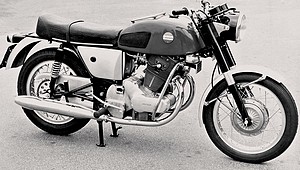
The second prototype of 1967, in its intermediate version; note the angular exhaust tubes and the steel rims. 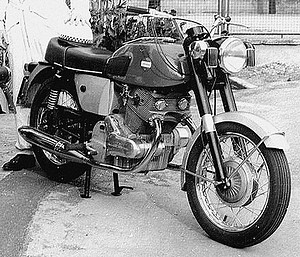
The second prototype of 1967, in its intermediate version; note the angular exhaust tubes and the steel rims. 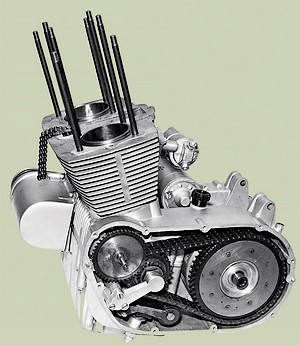
The first engine of the second prototype, July 1967 version. Note the experimental system supporting the crankshaft tail, held by the oil-pump body, as well as the particular shape of the primary cover. As with the starter, the excessive shrouding of the dynamo led to a lack of ventilation, hence internal corrosion problems, and the cover was removed on the production version. All the foundations of the definitive engine are, however, already there.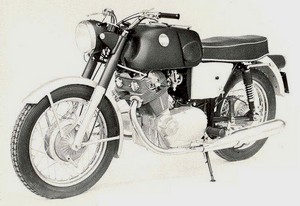
The first prototype of 1966.
The 650 (1968)
The 650 is the model that started the whole series of big-capacity twins in the Laverda range.
Produced in only 52 examples, the majority destined for the French market, they were built at the same time as the first 750cc models, which are identical apart from the capacity (75mm bore for the 650, 80mm for the 750), this capacity increase having been suggested by the man who would become the American importer, Jack McCormack.
The first (production) 650cc officially left the factory on 16 May 1968, the bikes being numbered from no. 1001, in the same series as the 750cc.
The technical particularities of the engines of these first models include, notably, crankcases without reinforcement (gussets) behind the cylinder block, a steel clutch drum with pins retaining the plates instead of screws, and very characteristic shouldered crankpins, which could sometimes pose breakage problems.
The major problem for restoring 650s today lies in the lack of availability of pistons, forcing the use and modification of 1000cc triple pistons or having them specially remade.
The engine delivers a power of 50 hp DIN at 6800 rpm, with torque of 5.2 m/kg at 5800 rpm. The pistons are flat, the compression ratio is 8.9:1. The camshafts are of the so-called "8" series. The carburettors are 29mm Dell'Orto VHBs. The intake valves measure 38mm in diameter, the exhaust valves 34mm.
The chassis features Borrani rims, Grimeca brakes (230/200), a wide tank with a rack, and a first type of frame whose rear loops sweep widely around the engine, at the expense of a certain rigidity at high speed. The instruments are Smiths, with a special 3/1 ratio (the very first being graduated up to 180 km/h then 240); the electrical equipment is entrusted to Bosch.
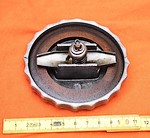
The tank cap of the first models. It would be used until the end of 1969 on the GT and the S, with two slightly different types of breather (a hole on one, a labyrinth on the other). 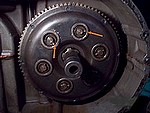
Steel drum and plain, clip-retained clutch-spring pins, characteristic of the first models (up to serial no. 5590). 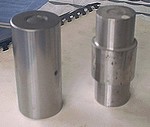
A shouldered crankpin from the 650 and early 750s on the right, compared with a crankpin from the later models on the left. 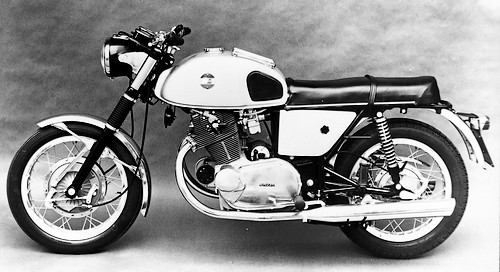
The 650cc. 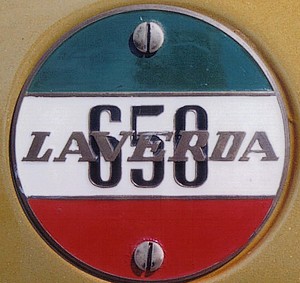
The tank emblem of the 650cc.
The 750 (1968 to 1977)
Produced from the start and therefore at the same time as the 650cc, sharing the same numbering in the series, the 750 benefits from bigger pistons (80mm, still flat-topped) which allow it to gain, at the start of its career, 2 hp (52 hp DIN at 6900 rpm) but also and above all greater torque (6.0 m/kg at 5600 rpm). As said above, this capacity increase was made at the instigation of the American importer McCormack, even though the Laverda staff had already considered this possibility, the engine being amply dimensioned (that's an understatement!). He hesitated at first, however: testing had shown good reliability in 650 form, but he did not want to compromise the reputation of his new model if the move to 750 were to create robustness worries. The pressure exerted by McCormack was enough for intensive testing to be carried out in 750cc form too, but only from the end of 1967.
This testing was conclusive on reliability, less so on the performance gain, the 750 being fitted with the same camshafts, carburettors and basic settings as the 650.
Nonetheless, the fashion already launched for big capacities prompted customers to order 750cc bikes in the majority, hence the few 650s produced.
The 750 and the 750 GT (1968, 1969)
At the start of its production, the 750 was simply called "750". Apart from the capacity, it was strictly identical to the 650.
However, from September 1968, the factory worked on an improved version of the 750, a more sporting model intended to be more in tune with traditional Italian production and to benefit from the robustness of the base model.
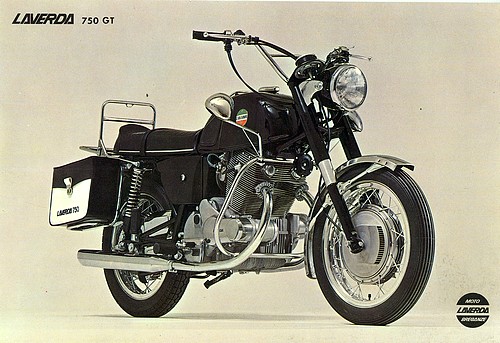
In view of the release of this new model, the 750 became the "750 GT" to affirm its more touring vocation. As a result, it fairly quickly received new optional equipment, including a high handlebar, a crash bar, a luggage rack and panniers.
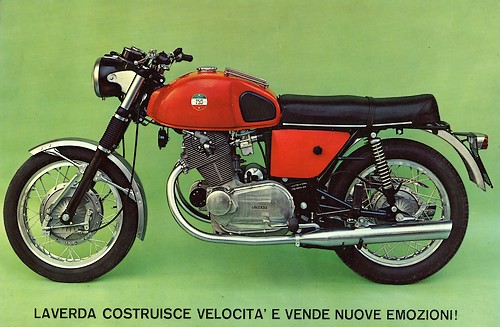
The 750 at the start of production. 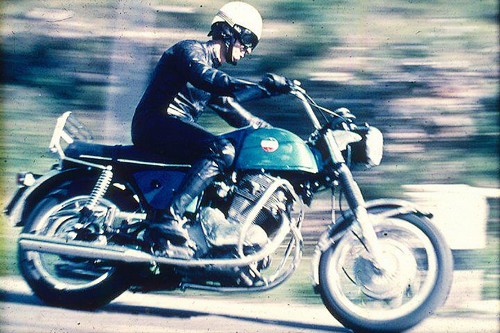
The 750 GT, here with the high handlebar and the luggage rack.
The 750 S (1969)
The new sporting model, christened "750 S", was designed from September to early December 1968, on the basis of a camshaft evolution that had already been tested on the base 750 in early 1968. The "S" was tested intensively at the end of December 1968 and the start of January 1969, then marketed in March 1969. It was fitted with a sport-style tank and seat, new rounded mudguards, a new frame that held the engine more closely, and a more powerful engine of 60 hp DIN at 6600 rpm (torque of 6.8 m/kg at 5600 rpm) with a lightened crankshaft, new domed pistons (9.65:1 compression) and 30mm Dell'Orto VHB carburettors. This engine first received one reinforcing gusset at the rear left of the cylinder block, then two, in order to avoid the crankcase cracking that had been observed fairly regularly on the earlier models (failure to tighten the engine correctly in the frame was quite often the cause).
It was available in two versions: one with Grimeca brakes (the front being different from that of the GT, though of the same diameter) and round 750 GT-type exhaust tubes; the other, in May 1969, with a different frame (lowered, more vertical rear shocks), first-generation Laverda brakes, exhaust tubes with a balance tube, and a further reworked crankshaft. Although both are called "S", the second model had better high-rev performance thanks precisely to this new exhaust and the crankshaft. Note a few rare examples of the first version whose rounded tubes had the balance tube. This model derived directly from the S prototype dating from 1968.
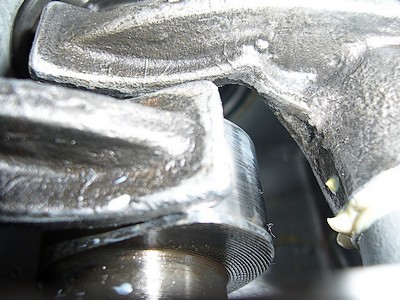
Profile of the new 4S-type camshafts. 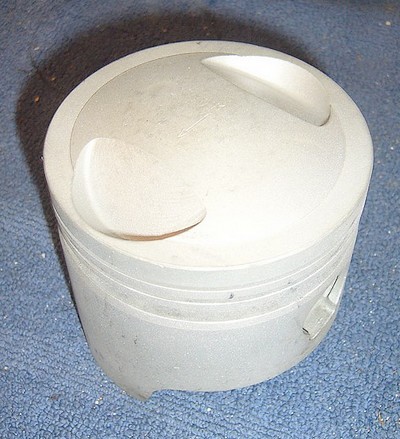
The new domed Mondial pistons, compressing at 9.65:1. Two types existed, with or without a reinforcing rib under the crown. 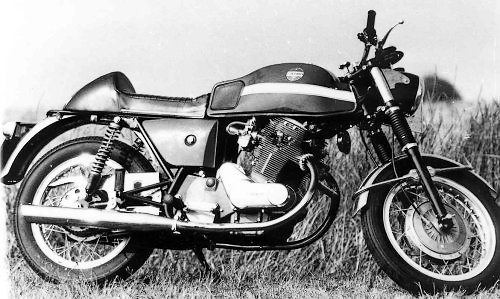
750 S first version with the balance tube on the exhausts. 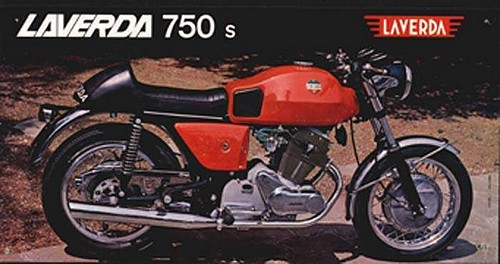
750 S second version (May 1969), Laverda brakes and new exhaust system. Note the more vertical shocks. 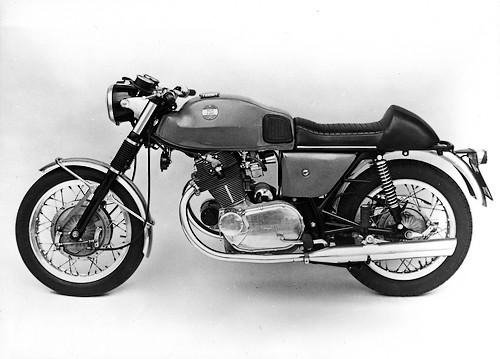
The 750 S first model, with the Grimeca brakes. 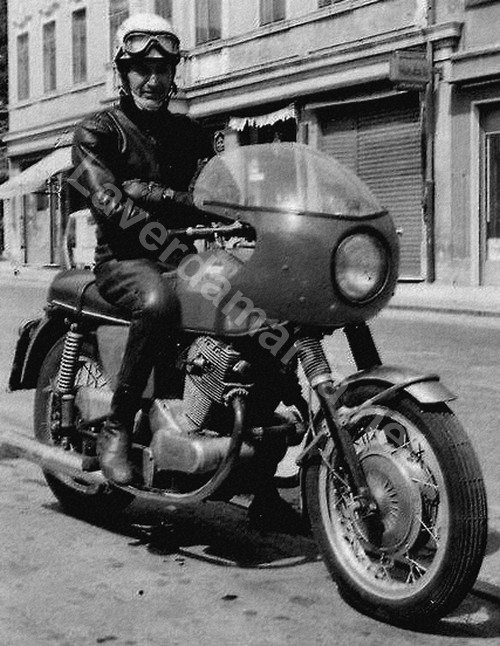
The 750 S prototype in November 1968. GT seat but a balance tube between the two exhausts.
The 750 SF (1970, 1971)
The 750 S second version in fact foreshadowed the model that would immediately follow, fitted with the patented first-generation Laverda-made brakes, which took the name "750 SF", SF for "Super Freni". The first SF bears no. 3800 (source: factory).
The SF carried over the engine, the frame, the suspension, the tank (except for the cap, which became a pivoting type), the general equipment (notably the Smiths instruments) and of course the first-generation Laverda brakes with cable-reaction operation that equipped the last version of the S. The new equipment included, notably, the optional dual seat, a new round rear light (CEV) and twin horns.
During production of the first SF version, the factory would change the clutch system, replacing the steel elements with lighter aluminium parts and screw fixings for the pressure plate.
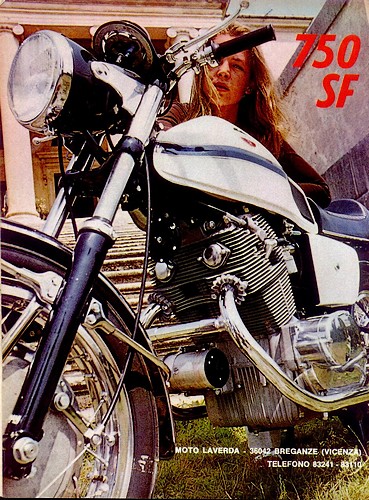
The 750 SF "0" (1971, 1972)
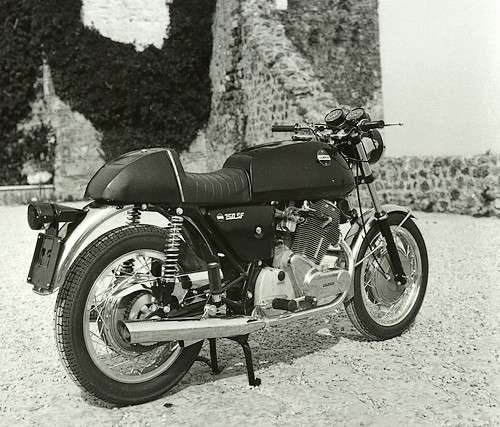
In the summer of 1971, the factory modernised its SF by fitting it with a new, less angular tank without knee grips, a Nippon-Denso speedometer/rev-counter set of the type used on the Honda 750 Four, and a seat available either as a one-and-a-half seater with a hump forming a compartment, or a dual seat. The frame again benefited from a few small modifications. The bike's presentation was unquestionably more modern despite retaining the large Bosch headlight.
Most of these models would be marketed from late 1971 until the autumn of 1972.
This SF would later be commonly identified as "SF0", when the following model, the SF1, was produced. "SF0" was, however, never an official factory name.
The 750 SF1 (1972, 1973)
The good endurance-racing results of the sporting version of the Laverda 750, the SFC, logically prompted the factory to draw on the experience gained in racing. The SFC-type head, as well as an evolution of the Laverda brake (now with linkage operation), were adapted to the 750 SF, which became the SF1. The left crankshaft ball bearing, which had sometimes caused problems, was replaced by a roller model whose outer cage is retained by a wide-headed screw, as on the gearbox shafts. A smaller, more modern front headlight (CEV) was fitted in place of the Bosch.
The new head was fitted with 41.5mm intake valves and 35mm exhaust valves. The carburettors went from 30 to 36mm, of the Dell'Orto PHF type with accelerator pumps. The camshafts were also new, of the "5/1" type — these would be the sharpest camshafts of the whole road-going 750 series. The compression ratio was reduced to 8.9:1. The exhaust system was entirely new, of larger diameter, and fitted with a large central balance tube under the engine. The silencers had reverse cones. Power rose to 65 hp at 7000 rpm.
The brakes were therefore the Laverda-made drums with linkage and external spring, second and final generation. The swingarm was now mounted on bronze bushes rather than on silent-blocks.
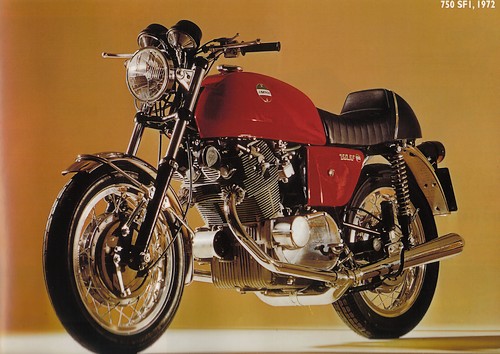
The 750 SF1, with its new brakes and above all all its new engine modifications, including a head derived from that of the 750 SFC competition bikes.
The 750 SF2 (1974 to 1976)
In 1974 the "SF2" appeared, the model considered by many to be the most accomplished and homogeneous of the whole series. Its decisive advantage came from its single Brembo front disc brake and, very soon after, twin discs. The engine was almost identical to that of the SF1 (fitting of intake valve-stem seals and modification of the primary chain tensioner, notably) but the camshafts were tamer and carried the code name "7/1".
The fork, mounted on wider yokes of a new type, was at the start of the series the 35mm Ceriani (with the single-disc brake), which became reinforced to 38mm with the appearance of the twin disc brake.
The general equipment was similar to that of the SF1 except for the Bosch front headlight.
In 1975, the SF2 received CEV indicators and a new Nippon-Denso lighting/indicator switchgear.
The 750 GT second version (1971-1975)
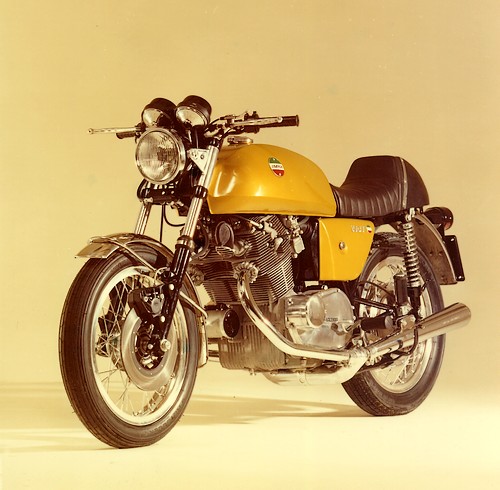
With the market (notably Italian) demanding a more touring model than the SF, the factory relaunched the GT model at the end of 1971, fitting it, however, with the SF's frame, engine and brakes. The bodywork was a mix between the SF (side covers) and the first 750 GT models, modified to fit the narrower SF frame. The tank and seat, notably, retained the general shape of the old models but the lower parts were modified for the new frame. Fork, brakes and exhausts remained those of the old models.
The 750 GTL (1975 to 1977)
At the end of 1974, with the planned end of GT production, the factory sought to offer a touring machine, less sporting and more docile for everyday use than the SF. It was during a discussion about this new project between Massimo Laverda and sports journalist Giancarlo Daneu that the latter suggested a few ideas for developing this bike. Massimo gave him a free hand to make proposals to the styling office. There was even a call in the press so that readers could suggest styling ideas. Daneu then provided design studies and a few technical solutions in line with the predefined specification. The bodywork was resolutely new, out of step with the SF, more oriented towards practicality and comfort. The tank was more rounded and less long, the seat thus becoming more spacious, the handlebar higher, all to the benefit of comfort and ergonomics. The rear light was a more modern rectangular shape. The passenger had a grab rail. The front headlight was first a 200mm Bosch, very quickly replaced by a 180mm of the same make.
The fork went back to the 35mm Ceriani, this time fitted with protective gaiters, and the brakes were the second-generation Laverda drums.
The significant modifications also affected the engine, since the compression ratio was lowered to 7.7:1 through the use of flat pistons and a thicker base gasket, and it was fed by the 30mm VHB carburettors of the older models. The exhausts remained of the SF2 type.
Thus equipped, the GTL was a bike particularly at ease for gentle touring and everyday use; unfortunately it had very limited commercial success, with only 251 examples produced. It nonetheless found an unexpected outlet from the end of 1975 and until 1977 and 1978, benefiting from commercial advantages subsidised by the Italian government for equipping the police forces of certain Italian towns and also (and above all) of several Middle Eastern countries including Syria and Kuwait, the bike then being specially equipped (single seat, fairing, etc.). Some of these services requested a few specific modifications, notably the installation of an alternator in place of the original dynamo, or the use of more compressed and more powerful SF-type engines. But there was also an inability of the factory (which had ceased production of the twins) to supply all the parts for the Police GTL specifications; consequently, some of these machines were built with different, SF-type parts.
Once their service in Kuwait was over, the machines were piled up in a hangar, then about forty of them were bought back and brought notably to Liverpool in England. Some could be restored, but very few have 100% original specifications.
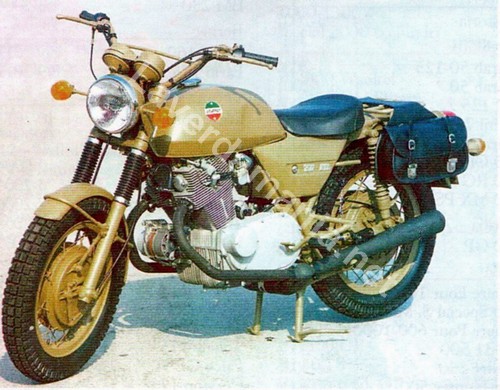
The 750 GTL prototype as presented to the Kuwaiti authorities at the end of 1974. 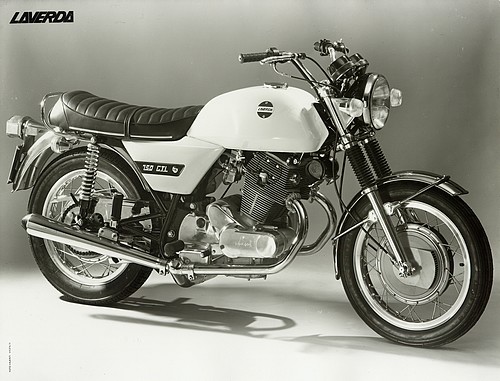
The base 750 GTL, practical, docile, pleasant and comfortable, but which would not enjoy the hoped-for commercial success.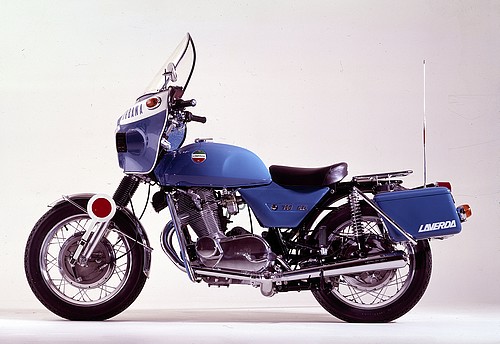
One of the versions for the Italian municipal police.
The 750 SF3 (1976, 1977)
In 1976, when the Laverda 750 was at the end of its potential, challenged by more modern foreign models and by the marque's own 1000 triple, the factory tried to give it new youth thanks to equipment borrowed from the 1000 3CL (seat hump, spurred wheels, pinstriping, etc.). The engine was similar to that of the SF2, as were the suspension and the brakes. It was the subject of a certain paradox: its equipment indeed allowed it to burnish its image, but its new style distanced it from fans of the more classic look of the previous versions, or from those who wanted to move straight to the similarly presented but more powerful 1000 triple.
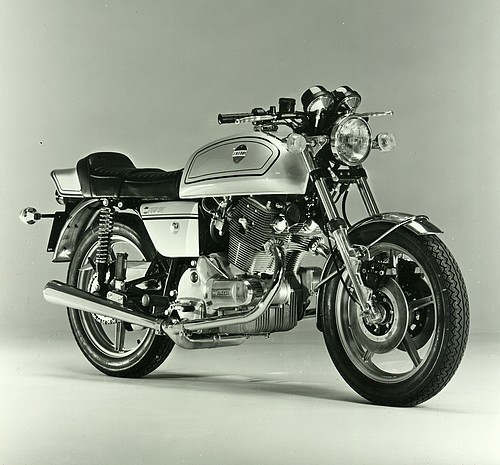
The SF3 with its 1000 3CL-type bodywork.
The 750 SFC (1971 to 1976)
From 1969, the Laverda 750 had demonstrated its aptitude for endurance racing. In 1970 in particular, a version of the SF that was ultimately fairly little modified won significant events and stepped onto the third step of the podium at the Bol d'Or. That was all it took for the factory to imagine a pure race machine based on the 750, called the SFC (Super Freni Competizione). Produced first as a customer-competition machine reserved for racing, then later as an exclusive sports model aimed at the general public, the SFC became a legend both through its excellent sporting results at the start of its career in 1971 and through its restricted production (549 examples in total).
The first models of 1971 and 1972 were therefore intended for pure competition, the very first examples being neither registered nor sold to the general public. Of fairly rustic appearance and finish, extremely exclusive, they have to their credit the best results in the most prestigious European endurance events, which simply made them the best endurance machine of the moment. Massive, sturdy, fast thanks to its top end, it won almost all the races of 1971 and finished 2nd at the Bol d'Or.
Modelled on the 750 SF, it nonetheless differed from it on many points: the frame was reinforced, the bodywork (aluminium then polyester tank) was special race spec, the engine had a specific head, camshafts, carburettors (Amal Concentric then Dell'Orto), exhausts, a (polished) crankshaft, and a (close-ratio) gearbox.
The power was 70 hp at 7200 rpm, each machine being run on the dyno at the factory.
This first series was offered in three distinct parts: a first part of 20 machines produced in May 1971, which had the same homologation number as the contemporary SF (DGM 5834 OM); a second part somewhat different from the previous one (bodywork, exhausts, pistons, oil pump, swingarm, brakes, etc.) comprising two series produced in September 1971 for a total of 88 machines, with a special homologation number (DGM 9217 OM), some examples of which were only sold in early 1972; and a third and final series produced in March 1972, comprising 55 machines, benefiting from a few more improvements and parts making the bike more usable on the open road.
These first SFCs are those that would build the legend by accumulating (notably in 1971) good results and victories in endurance racing.
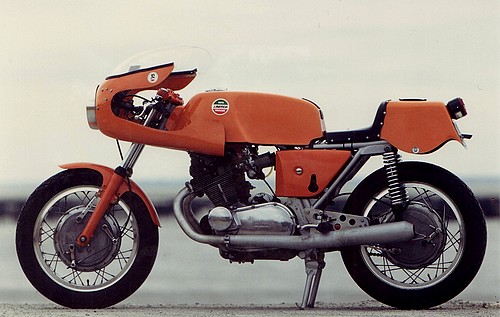
SFC first series, produced in May 1971 in only 20 examples, never registered and reserved for competition.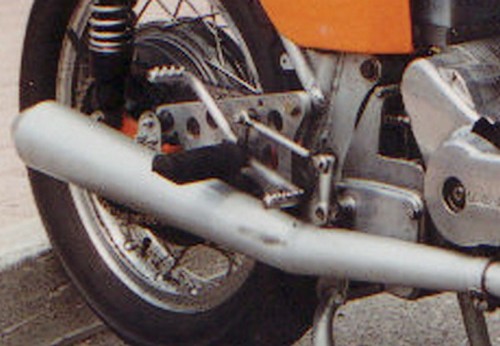
Detail of the two-branch shifter and the completely empty megaphones. 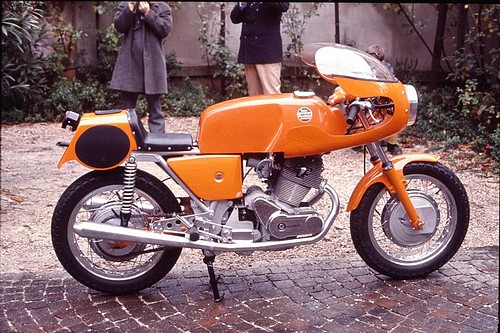
SFC second series, produced in the autumn of 1971, with many evolutions compared with the previous series. This version would be partly sold for road use.
After an interruption in 1973 due mainly to the move to the new factory, and apart from three very special SFC examples used as works race bikes, a new series of 386 750 SFCs was produced in several batches from November 1973 (marketed from the end of March 1974) until April 1976. This series is distinguished from the previous one by numerous modifications, the most visible concerning the adoption of Brembo disc brakes and a new, finer and racier bodywork. But a detailed examination quickly reveals that almost all the parts are different from the 1971/72 machines, including a completely new lowered frame.
At first, the engine also benefited from many improvements: compression ratio raised to 9.8:1, lightened crankshaft, new camshaft christened 5C with greater lift, reduced-diameter (7mm) valve stems, reinforced valve springs, a different head with intake ports enlarged to 36mm, timing-chain tensioner mounted on a needle bearing, Dell'Orto PHB36 carburettors, an optional 2-into-1, etc. Power rose to 75 hp at 7500 rpm, but it was above all the liveliness that improved.
The finish of these new machines was much improved, and one senses that their primary aim was to be marketed to the general public and no longer only intended for competition. In fact, even though these 1974 models were more powerful and eager than the first machines, and even though they enjoyed very good commercial success (the SFC was one of the few genuinely fast sports machines), they would have no real competition results apart from in Italian national events.
Among the 222 machines produced in 1973/74, 100 (built in two non-consecutive batches of 50) would be destined for the American market and would be equipped differently, with Nippon-Denso instruments (similar to the SF2), a mirror, indicators, a 1000cc-type rear light, a 1000 3C-type multi-position handlebar and side reflectors.
In March 1975 a first series of 130 machines of the last 750 SFC model appeared. Christened "Elettronica" because of its new Bosch BTZ ignition, it also benefited from significant engine modifications, with a head whose combustion chamber was completely redesigned, with a squish band, different valve angles, more horizontally positioned spark plugs, and an optional camshaft christened 6C. An oil cooler was fitted in the front position, 1000 3C-style. The frame was identical apart from a few brackets for accessories.
In April 1976, a second series of 34 Elettronicas was produced with spurred wheels of the same type as the 1000 3C.
The very last 750 SFCs left the factory at the very start of 1977 and closed this production of 549 examples.
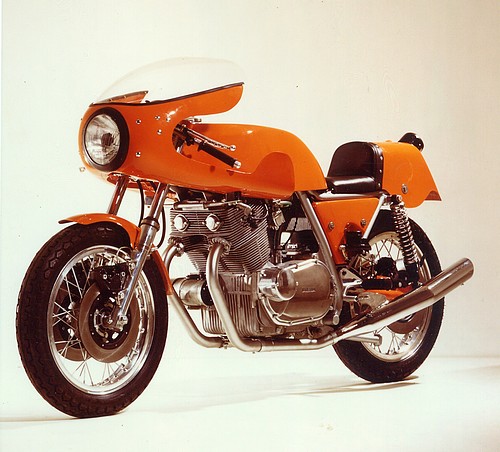
The new 750 SFC with disc brakes of 1974, European version. 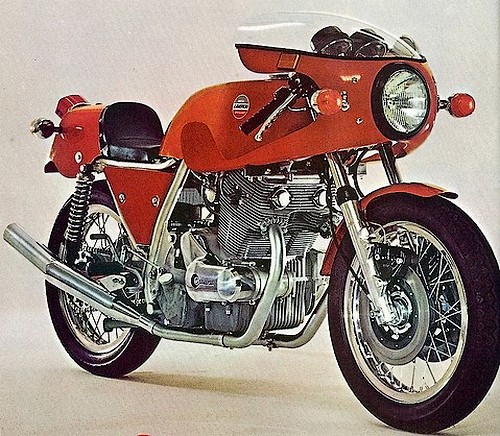
The American version with its homologation accessories. 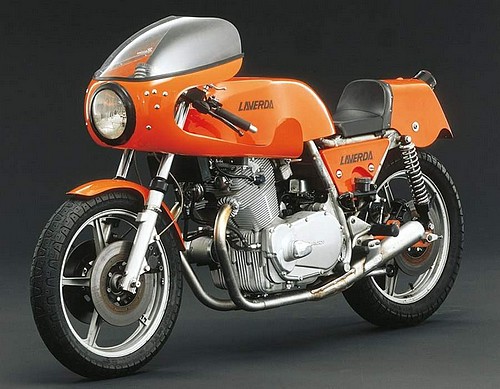
The 750 SFC Elettronica, the last version of the 750 SFC.
| Year | Model | Homologation no. | Frame type |
|---|---|---|---|
| 1968 | 650 | DGM 5932 | LAV.650 |
| 1968 | 750 | DGM 5932 | LAV.750 |
| 1969 | 750 | DGM 5934 | LAV.750 |
| 1969 | 750S | DGM 5934 | LAV.750 |
| 1970 | 750S | DGM 5934 | LAV.750S |
| 1970 | 750 GT | DGM 5934 | LAV.750 |
| 1971 | 750GT | DGM 5934 | LAV.750 |
| 1971 | 750 SF | DGM 5934 | LAV.750F |
| 1972 | 750GT | DGM 5934 | LAV.750F |
| 1972 | 750 SF | DGM 5934 | LAV.750F |
| 1973 | 750 SF1 | DGM 5934 | LAV.750F |
| 1973 | 750 SF1 | DGM 11068 | LAV.750SF |
| 1974/75/76 | 750 SF2 | DGM 12565 (except the very first single-disc SF2: 11068) | LAV.750SF2 |
| 1975/76/77 | 750 GTL | DGM 14215 | LAV.750GTL (but some last GTLs had the frame stamped 750F and 750SF) |
| 1976 | 750 SF3 | DGM 12565 | LAV.750SF2 |
| 1976/77 | 750 SF3 | DGM 12565 | LAV.750SF3 |
Production
| Year | Production (commercial data) | Production (Laverdamania est.) | Notes |
|---|---|---|---|
| 1968 | 650 | 550 | incl. 52 650cc |
| 1969 | 1150 | 1240 | |
| 1970 | 1900 | 2070 | 1st SF: 3808 |
| 1971 | 3654 | 2650 | |
| 1972 | 3446 | 5030 | |
| 1973 | 3689 | 3280 | |
| 1974 | 2127 | 1890 | |
| 1975 | 1221 | 1100 | 1st SF3: 18608 |
| 1976/77 | 789 | 820 | |
| Total | 18630 |