350/500cc
Note to the reader: The information given below concerns the various types of Laverda 350 and 500 as a whole. The factory did, however, occasionally but fairly regularly use different parts within a single series, notably depending on supply uncertainties from subcontractors. It is therefore not unusual for bikes from a later series to have been fitted with engine or chassis parts from an earlier series, or for two bikes from the same series to differ slightly — this being in no way proof that a model is not original.
Photos subject to copyright (Laverda factory, Laverda family, G. Sperotto, JL Olive; reproduction forbidden without permission of the rights holders)
The 500cc (or Alpino or Zeta), 1977 – 1982
In September 1975, Laverda presented a prototype of a small 500 twin whose idea dates back to the end of 1973. It was a 497cc twin apparently much resembling the marque's triple. But this was only appearance, because this engine used resolutely modern techniques to compete on equal terms with the new Japanese 500s: four valves per cylinder, twin overhead camshafts, 180° timing, electronic ignition, six-speed gearbox, and a featherweight of 171 kg — nearly 40 kg less than the one the press presented as its direct rival, the Yamaha 500 XS…
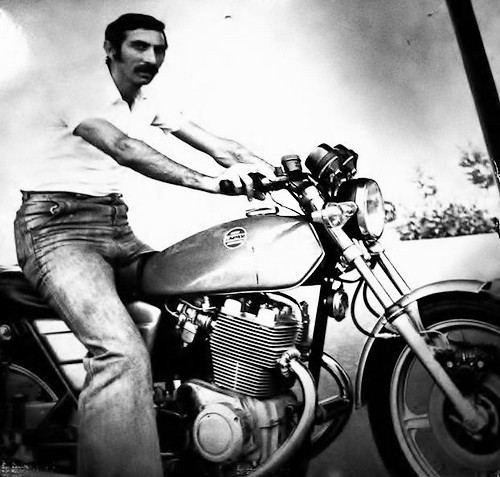
The prototype of the 500cc, photo taken at the end of 1974. Collaborator Giulio Franzan is at the handlebars; he was a great enthusiast for this project. 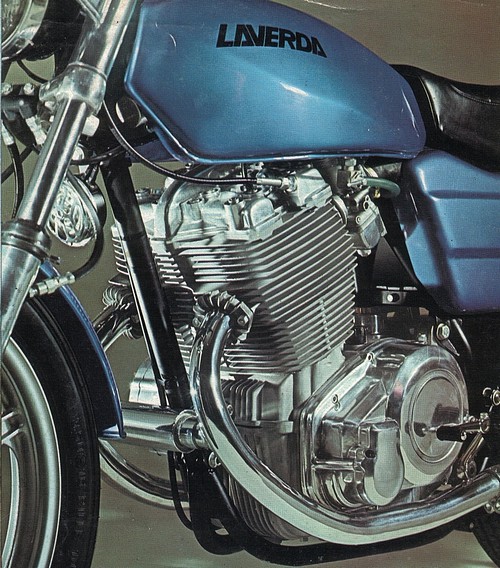
The particular ignition cover of this first prototype, as well as the round exhaust tubes and the painted front mudguard.
Well conceived and without major flaw, this prototype nonetheless took some time to be marketed, owing to certain difficulties of the small Breganze factory in handling several major projects at once (the 750 and the 1000 were in full swing) and above all because of the appearance in 1975 of a new Italian tax regulation heavily taxing (35% instead of 18%) motorcycles over 350cc. Moreover, galloping inflation made Italian bikes hard to sell for export, all of which limited the success of this bike, which was nonetheless particularly successful and high-performing, recognised as such by the specialist press.
In fact, the second prototype of the 500, almost finished, was only presented to the public in 1976 at the Milan and Paris shows.
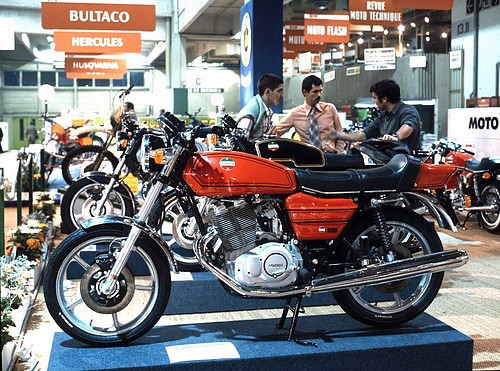
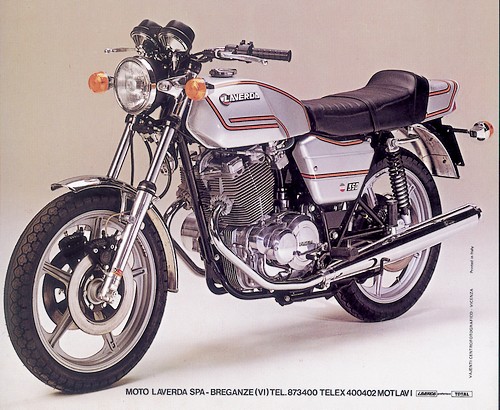
Finally, the definitive model was marketed from 1977, its commercial name being "500" everywhere in Europe except in England, where it took the nickname "Alpino", and in the USA, where it was called "Zeta".
This first model was close to the 1976 prototype. The primary cover featured a more conventionally shaped housing for the ignition, and the cam cover was different.
On paper as well as in testing, the Laverda 500 was truly a credible solution to rival the Japanese machines, and often took the advantage in comparison tests. It was technically very sophisticated, pleasant to ride, lively and light, handling very well; the engine was eager and able to rev quickly — there was nothing but praise to give this bike.
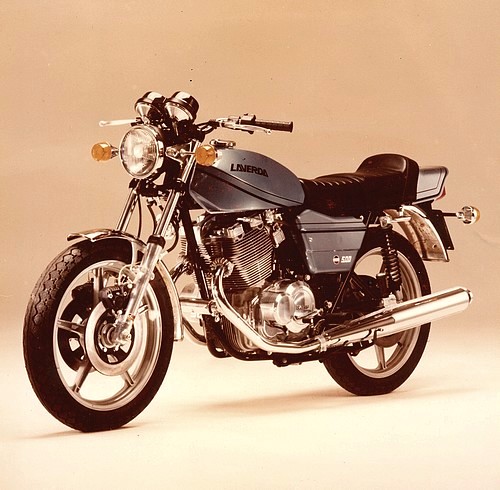
The 500 of 1977, first version.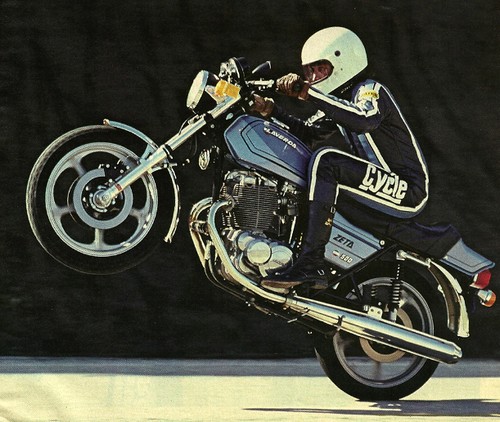
The 500 was called "Zeta" in the USA (ph. Cycle Guide) 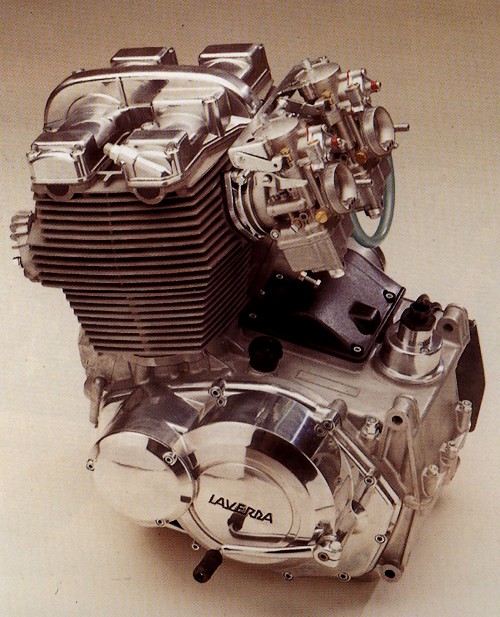
The very handsome engine block of the 500cc, compact, light and highly advanced (here in 1978 form).
The factory was therefore deeply affected by the bad luck that dogged this little gem, despite all the efforts it had made to design an exceptional machine — the first bike to be offered with four valves per cylinder, the first Italian bike with a six-speed gearbox, light and sporting yet at the same time versatile… The taxation specific to big capacities, the exchange rate of the Italian lira, and even a certain lack of identity compared with the marque's other products, very strongly thwarted its potential success… The American magazine Cycle Guide even titled it "The world's most expensive 500cc roadster".
Some salvation nonetheless came from Spain, where the protectionist policy towards Japanese products favoured sales of the Laverda 500.
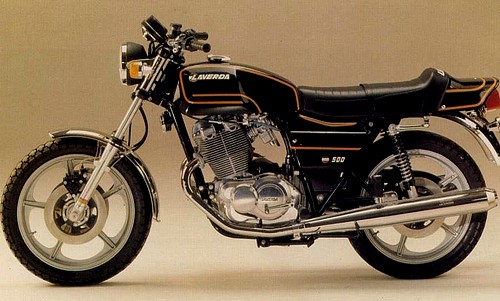
Although the bike was already particularly accomplished, in the middle of the following year the factory fitted a balancer shaft to cancel out any vibration. The presence of this balancer was visible from the particular shape of the primary cover, which had an additional boss. The tank (slimmer) and the general decoration also evolved. This new version was sometimes called "500 S" depending on the importing country. Note a small modification of the outer camshaft bearings, which became plain instead of needle bearings, this change having the sole aim of reducing running noise, reliability between the two systems being identical.
The same year, in order to get around the problem of heavy taxation of the 500, a 350cc was produced. For reasons of economy, since the 500 project had already suffered greatly from the vicissitudes imposed by the Italian authorities, the 350 was directly derived from the 500. Same frame, same engine basis (only the bore differed, dropping to 60mm with low-compression pistons instead of 71mm), the only minor technical differences being the carburettors (24mm), the intake manifolds (smaller and without reinforcing gussets), the exhaust tubes (smaller and without a balance tube on the 350, ref. 63101026 on the 500, ref. 63101035 on the 350), a 14-tooth gearbox output sprocket instead of 15, and finally the engine number on the crankcase does not carry the type and DGM homologation number on the 350.
The 350 was a good machine, reliable, but with performance clearly down on the 500 because of an identical weight to carry. But its price was much more affordable and, as a direct consequence, it sold better in Italy than its big sister, and also in Spain. The factory even offered, from 1979, a 400cc kit for owners of the 350.
The excellent aptitudes of the Laverda 500 for racing naturally prompted the factory to create competition models, such as the 500 Formula, which is the subject of the next chapter. On the same preparation basis (it is remarkable to observe that, unlike the 750 SFC compared with the production 750s, the race machines remained very closely derived from the production machines, notably with an identical chassis and many shared engine parts), the factory developed a race bike that was entered in the Barcelona 24 Hours. Ridden by Augusto Brettoni and Pete Davies, it won the race in its class, without any reliability problem.
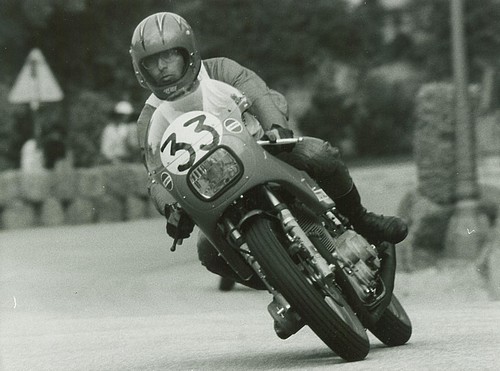
Laverda repeated the feat in 1979, with the same bike and the same riders!
The 500 also distinguished itself by winning its class in the Tour de France moto (rider Georges Fougeray) and also at the TT, notably in its Formula version, the subject of the next chapter.
The 500 continued its career until the start of 1982, most of the last models sold having been built in 1980.
Given the qualities of the 500, which also shone in competition (see next chapter), the obstacle that was the appearance, shortly before its launch, of the famous Italian surtax is still considered an immense waste.
But the 500 took its revenge much later, since it is its engine that would serve as the working basis for the 650 and 750cc models produced in the new Zane factory until the early 2000s, almost 30 years after its original design!
Production of the 500 and 350
| Type | Year | Production |
|---|---|---|
| 500 | 1977 – 1982 | 2750 |
| 350 | 1978 – 1980 | 2280 |
The 500 Formula (1978 – 1980)
Besides the fact that Laverda always had success with its most exclusive models, despite their high price, the 500 had great sporting potential from the outset. Its reliable and, for the time, highly advanced engine allowed a high level of development, and it was logical that Laverda would offer a sporting version of its new model.
This version was designed as early as November 1977, presented to the press on 22 January 1978, and a first batch of 75 machines was produced in February and March of the same year.
The principle was to design a race bike very closely derived from the base 500, to build it in a limited series, and to create a one-make championship called the "Coppa Laverda", an idea suggested by champion Augusto Brettoni.
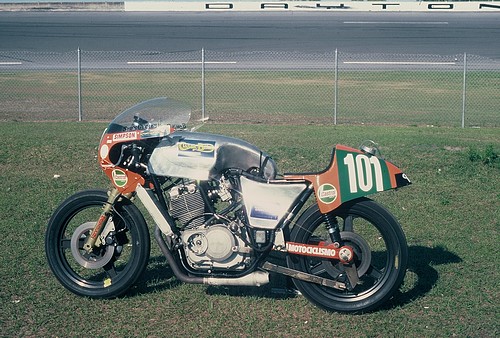
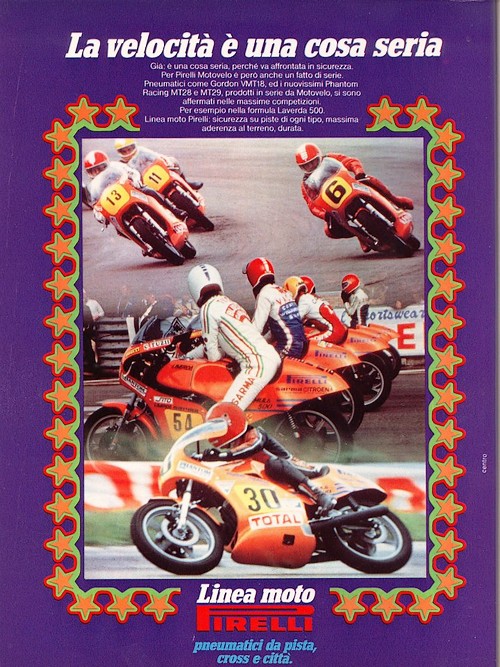
Around the production frame, the Italian specialist Motoplast was called upon for the polyester monocoque bodywork, and the engine was prepared with pistons compressing at 10.5:1, racing camshafts christened "S1", free exhausts, a high-flow oil pump and a close-ratio gearbox. Pirelli Gordon tyres were fitted.
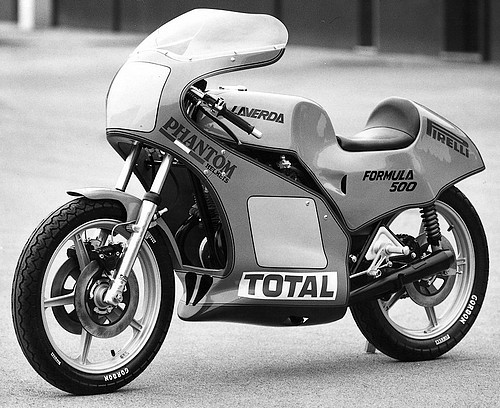
The prototype of the 500 Formula, presented in January 1978. 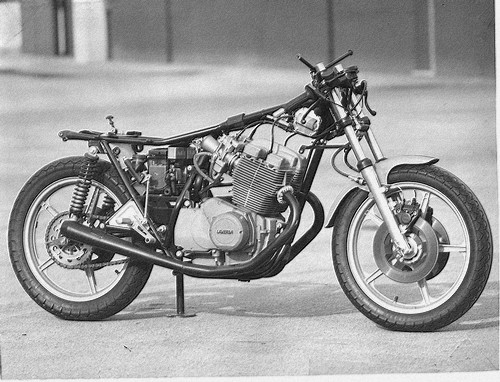
The frame is standard but the engine is prepared using traditional methods: high-compression pistons, racing camshafts, close-ratio gearbox, free exhausts.
Thus prepared, the Formula produced 52 hp at 9500 rpm and weighed 154 kg, an excellent power-to-weight ratio allowing a top speed of 220 km/h and above all making the machine very lively — while it was already agile as standard — particularly at ease on twisty circuits, including the TT, where it would shine through its qualities.
These bikes were not registered (reserved for pure racing) but the factory supplied, if needed, a road kit and a homologation file if an owner wanted to use it on the open road. They cost only 10% more than the production model (3,000,000 lire).
To help the Coppa Laverda entrants, the factory offered spare parts at reduced prices: pistons cost 13,200 lire each, the camshafts 35,600 lire (intake) and 31,200 lire (exhaust), the fairing 43,000 lire, the tank/seat shell 81,000 lire, the speedometer 25,000 lire, and the tyres about 30,000 lire each.
In addition, the factory sent a truck to each event with spare parts in case of breakage, which spared entrants from building up a stock in advance.
At the end of March 1978, the 75 first machines making up the first series were lined up in the factory courtyard and presented to the press.
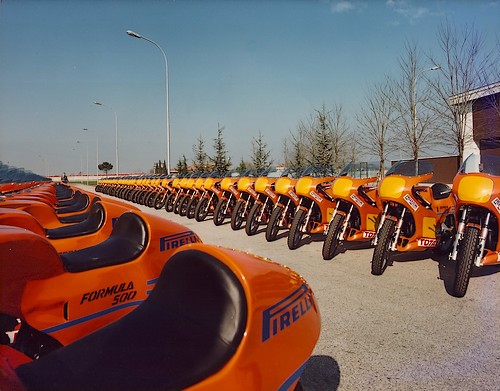
The "Coppa Laverda" was held four years running in Italy and Belgium (1978, 1979, 1980 and 1981) and in Germany in 1979. For the first edition, the rules stipulated that riders should be no more than 30 years old and never have finished in the top three of a national championship. This rule was abolished for later editions.
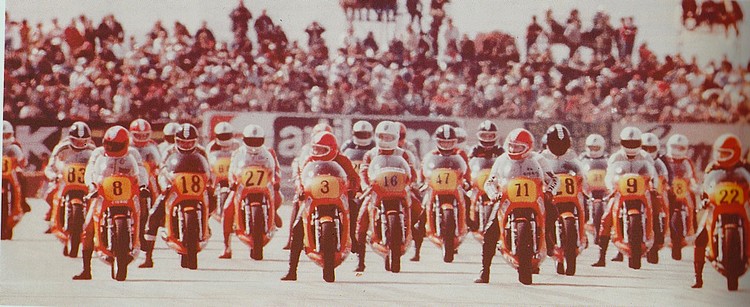
In 1978 also, the Laverda 500 was entered in the TT on the Isle of Man and finished 6th overall in the hands of Pete Davies, also production champion on a Laverda 1000 Jota.
At the end of the first season, the technical assessment was excellent, but there was just a request to make mechanical access easier for maintenance operations, which was made awkward by the monocoque bodywork. Adopting a separate steel tank was, moreover, a requirement for the championship in Germany. Laverda therefore redesigned the bodywork for the following seasons, using a separate tank (that of the production 500) and seat. Engine-wise, the '79 model also received a new Sito exhaust system. A new batch of 75 machines was produced in this configuration.
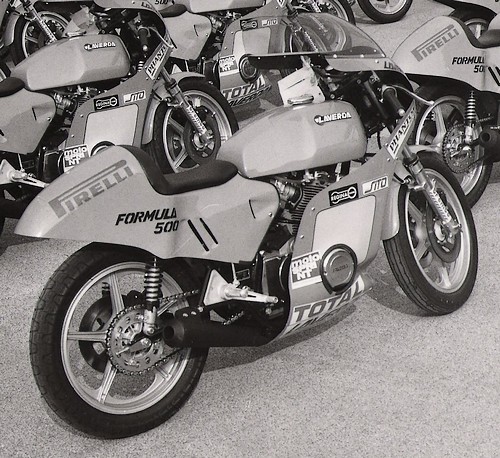
The 1979 Formula, with its separate tank and its new exhaust. 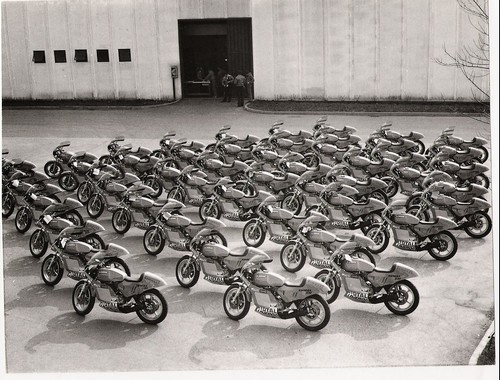
Presentation of the new 1979 series.
The Coppa Laverda enjoyed increasing success and was also organised in Germany, with different sponsors.
At the TT, it repeated its feat (5th place) in the hands of rider Mick Hunt who, like Pete Davies, also competed in the production championship on a Laverda Jota.
For 1980, the Formula remained identical to the 1979 model, but with some different sponsors. As some bikes had been destroyed in crashes in 1978 and 1979, the question of putting Formulas back into production for the 1980 and 1981 seasons arose. Even though no concrete information could be obtained on this, there is no doubt that a new small series was made in 1980.
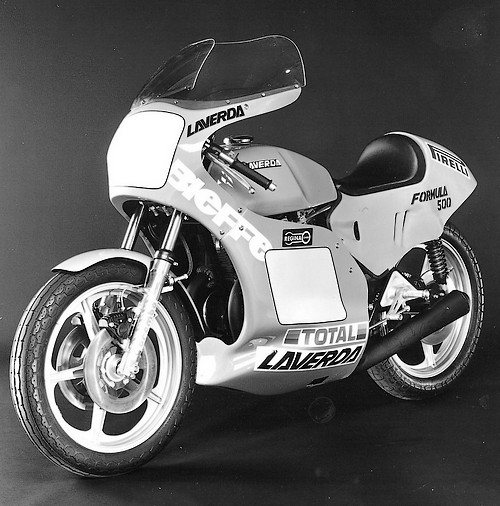
The 500 Formula, 1980 version.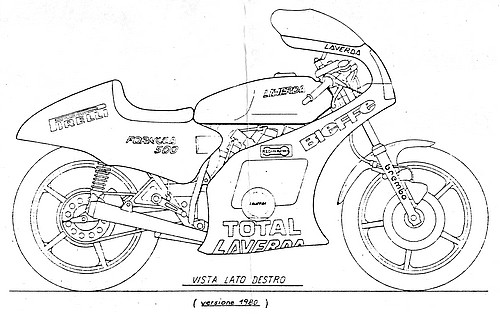
The advertising markings made compulsory in 1980. 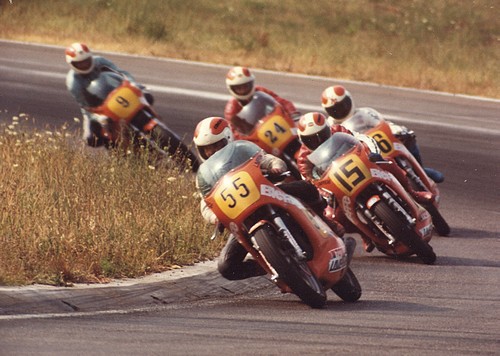
Racing at Misano. 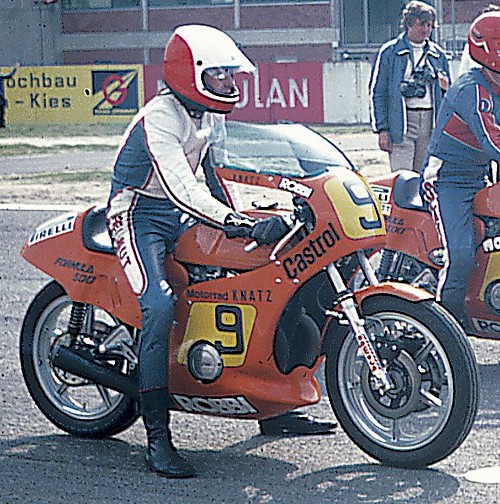
The specific livery of the 500 Formula for the German Cup.
At the same TT in 1981, Pete Davies finishes 10th; the Formula is starting to show its age and it is time to improve it. On a specially prepared machine, rider Malcolm Wheeler finishes 4th!
From then on, and for another 10 years (!), the Formula would take part in the TT, placing honourably (most often in the top 10) even though it was no longer being made!
During the 1981 race, a prototype 500 appeared, bored out to 579cc, developed by the wizard Maurice Ogier. The bike was in the development phase but was very promising… The following year, in the hands of rider Alan Cathcart, it led from start to finish and won the BOTT at Daytona. The ease of this victory and the top speed achieved led to protests, and the engine was ordered to be stripped for checks. After inspection by the sporting authorities, it was found to be perfectly compliant!
The 500cc Montjuic, 1979 – 1982
Boosted by the sporting results of the 500 but also eager to help its commercial rise, the marque's importers rightly thought that a sporting version aimed at the general public could be a great success.
So it was in Austria, with two sporting 500 projects, one called S and the other SS, with capacities between 500 and 550cc, and even 650cc with a complete new block, but the financial risk was ultimately not taken.
In Germany, on the other hand, importer Uwe Witt brought out the 500 "SFC", fitted, at the customer's choice, with a Formula or 750 SFC seat, a 750 SFC fairing, or even a Formula-type engine.
But it was above all in England that things became much more concrete, with the production of an exclusive sporting machine christened the "Montjuic", a bike named after the Barcelona circuit where the 500 had just won its class.
Fitted with an engine very close to the Formula (S1 camshafts, high-compression pistons and SITO exhaust), it had special bodywork with a 750 SFC seat and a small fork-top fairing fitted directly in England.
To understand the success of the Montjuic, two major facts must be taken into account: on the one hand, there was always a craze for the special, small-series Laverdas, which were quickly pre-ordered by a clientele hungry for exceptional machines (one can even say that these special series greatly contributed to restoring the company's finances, at least until the early 1980s). On the other hand, at a time when motorcycle production was becoming seriously sanitised — including, in a way, within the marque's own models — the Montjuic was the typical representation of the "rebel" bike, antisocial in its performance, its character and even its noise level! For the same reasons, it recalled the legendary Jota. In this light, it was neither more nor less than a race bike let loose on the road, homologated goodness knows how and capable of matching many contemporary superbikes.
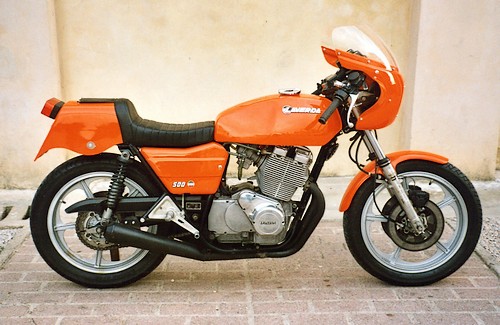
The 1979 Montjuic, also called MKI, in all its splendour as a race bike on the road. 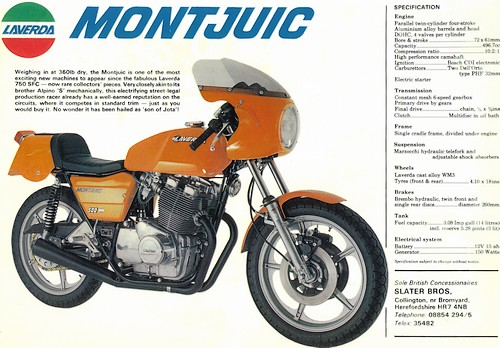
The English importer's advertisement in 1979; reference was made to descent from the 750 SFC, but it was in fact the 1000 Jota that this bike was closest to.
At the end of 1981, the demand for a new, more modernised Montjuic was so pressing that the "MK2" model was produced at the very start of 1982. Its still expressive and high-performing engine was retained, but the bodywork and general appearance were modified thanks to a new fork-top fairing, this time fixed to the frame, and a rear monocoque assembly. Incredible as it may seem, the SITO exhaust with its 105 decibels was still part of the equipment on simple request!
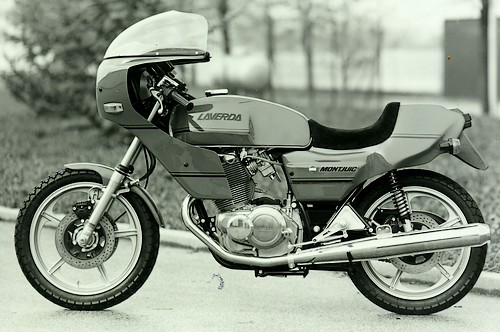
The Montjuic MK2, produced in 1982, with its new presentation. Here with the standard 500-type exhaust, which was most often replaced by the SITO. 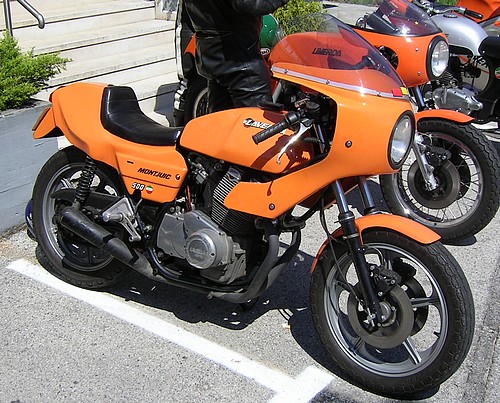
A MK2 at a marque meeting.
The 600cc TT2
Given the widely demonstrated sporting aptitudes of the Laverda 500 and the racing categories, with the TT2 championship in the background, it was natural that the factory would produce a larger-capacity engine kit, in this case in the 600cc class.
A first kit was offered with a capacity of 579cc, comprising liners, pistons, camshafts, valves and their springs and tappets, and most often an additional oil cooler and special exhausts. This kit caused some reliability problems at very high revs in extreme conditions, notably because of slightly too heavy pistons. Lighter pistons were then fitted, simultaneously with a further capacity increase to 596cc.
Rival companies offered their own kit, with roughly the same specifications.
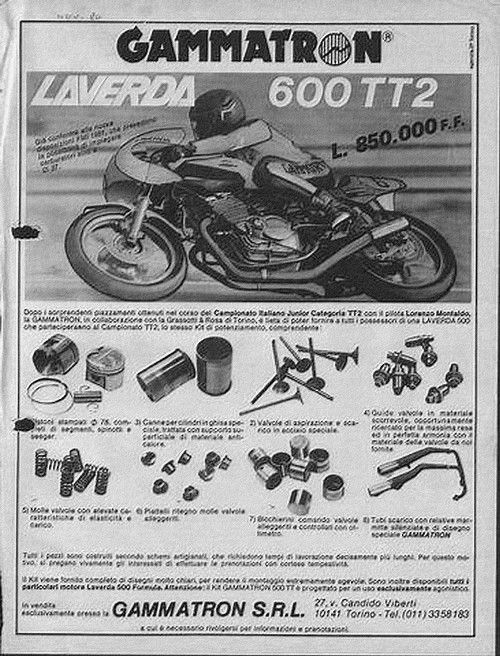
For the championship, a new very light (8 kg) trellis frame in chrome-molybdenum tubes was created, and the bike was fitted with the highest-quality components possible — magnesium suspension, big brakes, all lightened parts… Besides the 600cc kit, the engine was prepared to the maximum, delivering, depending on the case, between 71 and 74 hp, for a top speed above 230 km/h.
The 600 TT2 distinguished itself in the hill-climb championship, which it won in Italy in 1982 in the hands of Stefano Pagnozzi, but also in other kinds of events such as the Junior championship in 1984 with a certain Augusto Brettoni (2nd behind Barchitta's Ducati), and also at the TT where it finished 4th in the hands of rider Malcolm Wheeler, at an average of 161 km/h, an average further improved the following year to 168 km/h — remarkable results given the bike's age and its capacity.
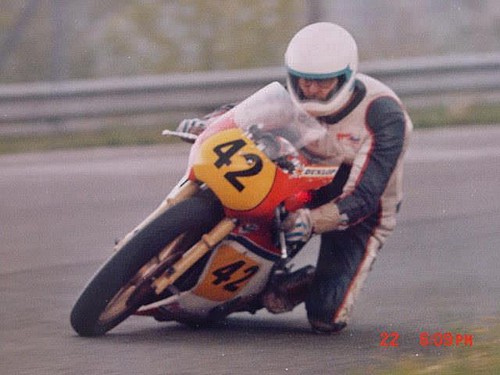
Cesare Caielli in the Italian TT2 championship. 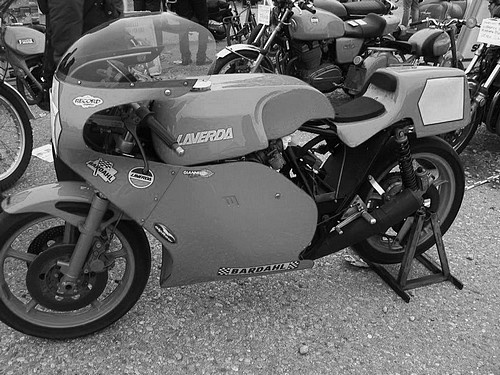
A version of the TT2.