1000/1200 cc 180°
Note to the reader: The information given below concerns the various types of Laverda 1000 and 1200 as a whole. The factory did, however, occasionally but fairly regularly use different parts within a single series, notably depending on supply uncertainties from subcontractors. It is therefore not unusual for bikes from a later series to have been fitted with engine or chassis parts from an earlier series, or for two bikes from the same series to differ slightly — this being in no way proof that a model is not original.
Photos subject to copyright (Laverda factory, Laverda family, G. Sperotto, JL Olive; reproduction forbidden without permission of the rights holders)
The prototypes and pre-production machines (1969 – 1972)
Two major prototypes were produced in 1969 and 1970.
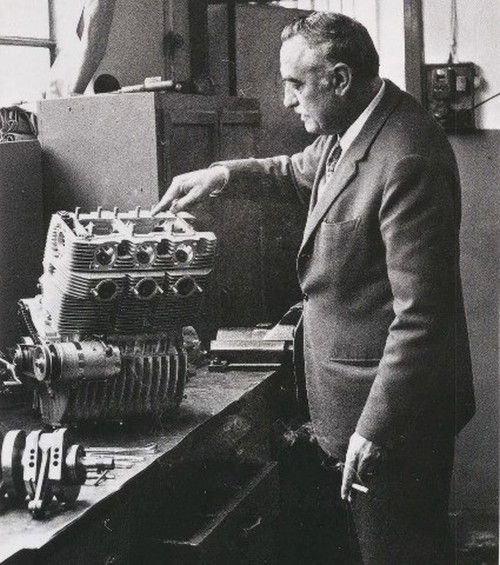
Design work on the first prototype began in November 1968 and the example itself was built in early 1969. It is a blatant extrapolation of the 750 twin, to which a cylinder was added to reach a capacity (exceptional for the time) of nearly 1000cc. As a result, the engine is a simple overhead-cam unit, with inspection covers for adjusting the rockers, and even the side casings recall those of the 750. The chassis also carries over equipment from the twin, notably the suspension and the Grimeca brakes. The timing was then conventionally at 240° (crankpins at 120°) and the ignition was by contact breakers, but it was clear that this first model deserved real development, as the engine and the chassis equipment were plainly too rustic for the marque's flagship. On the engine side, it had to contend with mediocre efficiency owing notably to the inertia of the moving parts, thermal problems on the central cylinder, and also significant mechanical stresses on a very long crankshaft and because of the side drive of the timing.
The factory then set out, at the end of 1969, to design and build a second prototype (which evolved at least twice in a major way), whose main improvement concerned the cylinder head, since this new engine was a twin-overhead-cam unit, then driven by toothed belt. This model was the subject of the most intensive testing, from which all the consequences were quickly drawn: while the timing remained at 240° at the very beginning, it suffered repeated bearing failures and transmitted unpleasant vibrations (tingling) to the chassis. It should be remembered that crankshafts of this length were then very rare, and that balancing them on a three-cylinder engine was a real headache, since it is impossible to oppose the respective forces of the moving parts except by compensating for them with a complex and costly balancing system, whose additional drawback would have been to widen the engine still further. The resulting oscillating stresses quickly got the better of the bearings of the time, even though the contemporary 750 also had a few worries on that score on the early models.
Technical chief Luciano Zen therefore decided to create conditions more favourable to an opposition of the moving parts thanks to a novel timing which is in fact a combination of the 360° and 180° timings, the two outer pistons being aligned and opposed to the central piston. This gives a 180/180/360 cycle (instead of 240/240/240 for the 720° needed for the complete cycle), which avoids the reciprocating oscillating stresses on the moving assembly and allows rigid mounting in the frame. In terms of dynamic behaviour, the closeness of the first two power strokes gives a "big bang" effect which, on the other hand, has to compensate for the inertia of the third. This solution favours feel and mid-range torque, provided the tuning is particularly careful — failing which the engine loses its power and becomes rough, a victim of the inertia of the third cycle which can no longer be properly compensated.
This second type of engine was immediately fitted with a toothed-belt-driven timing, an avant-garde solution in 1970. As this belt had to work in good conditions (out of the oil but under a cover) and had to be easily replaceable for regular maintenance, it was placed at the far right, against the outer face of the head and the right-hand cylinder. The aesthetics of the belt cover were debatable, but the belt itself proved perfectly reliable during testing. On the other hand, there were problems related to the lengthening of the crankshaft, which had to drive the entire timing and the alternator in an overhung position, with no real possibility of adding an extra bearing. Another worry concerned the cooling of the head on the right-hand side, the finned surface being reduced and partly masked by the belt cover.
The solution of a central chain drive was therefore adopted, except that a single chain was used (duplex on the 750s) to keep the weight saving that the twin-cam system allowed. In parallel, the head evolved greatly up to its definitive version. Tuning work could begin, until a power of 80 hp at 7250 rpm was obtained, making it one of the superbikes of the moment.
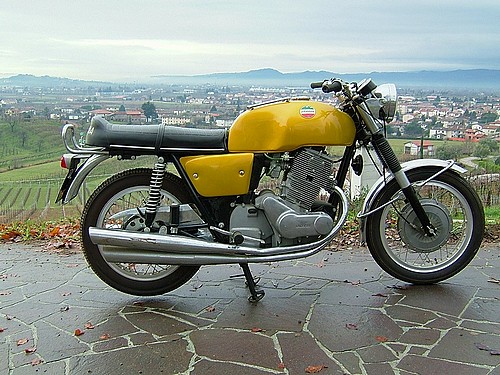
The first prototype of 1969. Asymmetric exhausts, engine modelled on the 750, Grimeca brakes, double-cradle frame.
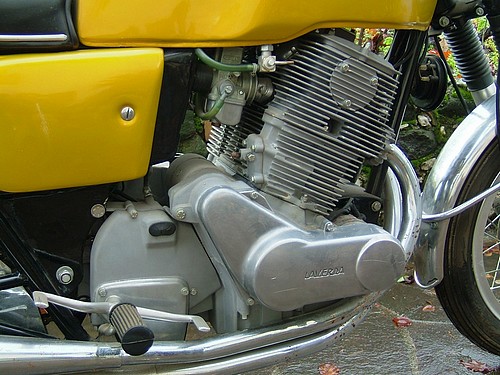
The engine is a single overhead cam (in two parts), driven by a side chain.
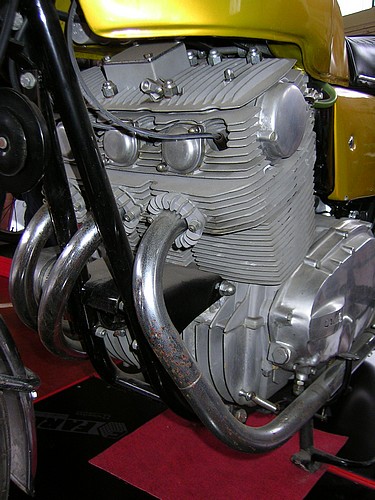
The ignition is by contact breakers, located on the left-hand side of the head.
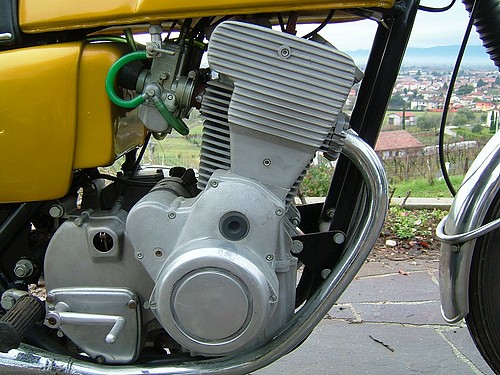
The belt-drive timing cover, located at the far right of the cylinder block.
The pre-production series (1971)
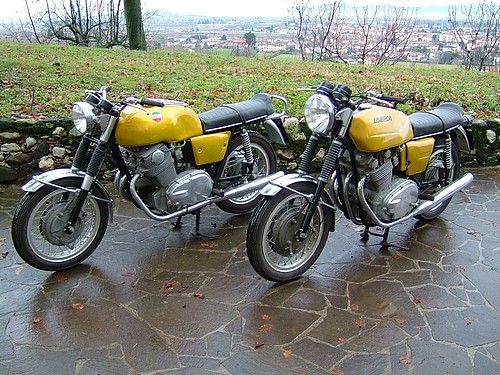
Between the second and last prototype and the beginnings of large-scale production intentions, there were at least two pre-production bikes: the first has sometimes been called the "third prototype" because it received significant modifications, notably to the head, and the second (almost identical) was built for market-testing purposes (in this case the American market, since the first bikes were destined for it). This latter escaped numbering within the type series. This bike was produced in May and June 1971 and, while the series was going to start conventionally with no. 1001, it was numbered "001". It is not known whether this numbering was solely for US homologation purposes or whether it was to distinguish the two first pre-production machines. No reliable information could be found as to the possible numbering of the other machine.
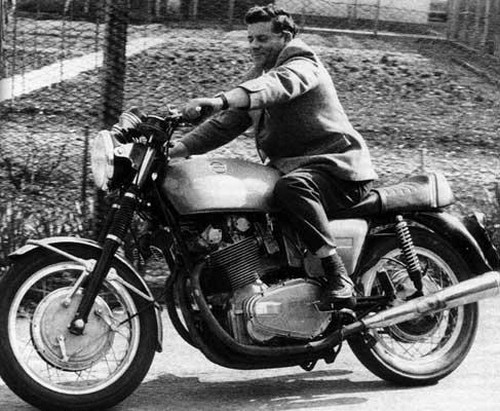
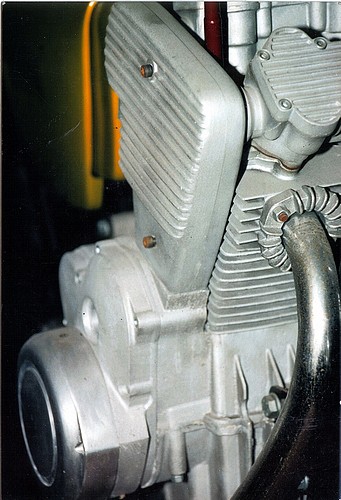
These bikes are interesting because they were fitted both with parts that would be found on the production models and with specific parts. Such is the case, for example, with the sharp-angled handlebar or the alternator cover, which comes from the second prototype. The photo below shows no. 001 about ten years ago; some elements are not original (exhausts, seat) but one can still see the special handlebar, the polyester tank, the ribless primary cover and the very special serial number on the crankcase.
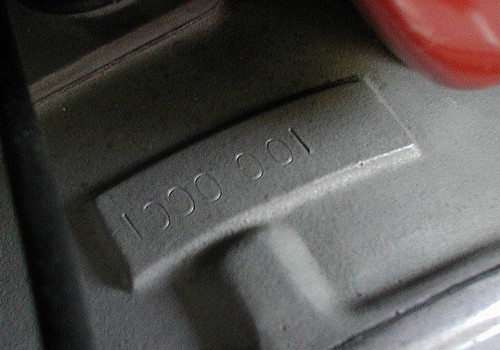
The specific numbering on the crankcase.
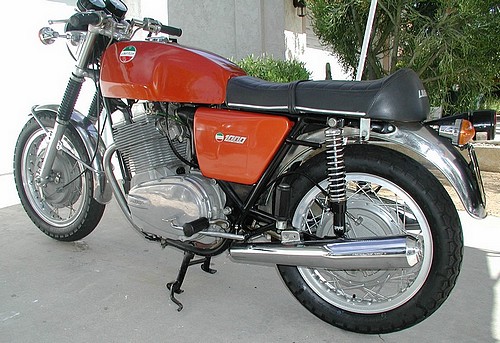
The official launch in 1971
The development of this bike took longer than expected; Massimo Laverda wanted a finished machine, the only way not to suffer too much from the fierce competition set by the release of the Honda 750 Four shortly before. But the work was such that the very first examples were only completed in October 1971 (notably for the Milan show in November), and it took until the end of August 1972 for series production of the definitive version to really begin.
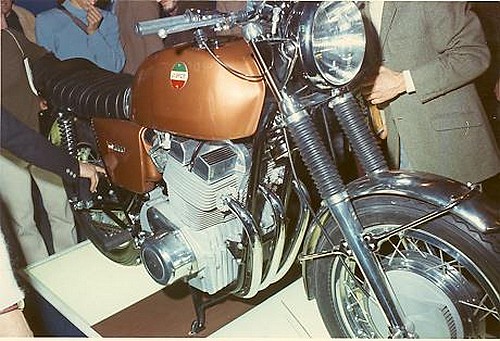
Here are a few photos of the example unveiled at the Milan show in November 1971; these shots were taken a week before the show opened, during the visit of Laverda's importer in Sweden, Hans Blomqvist.
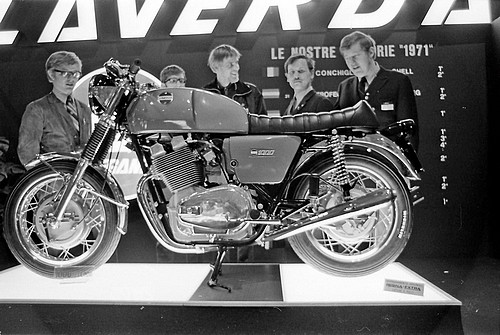
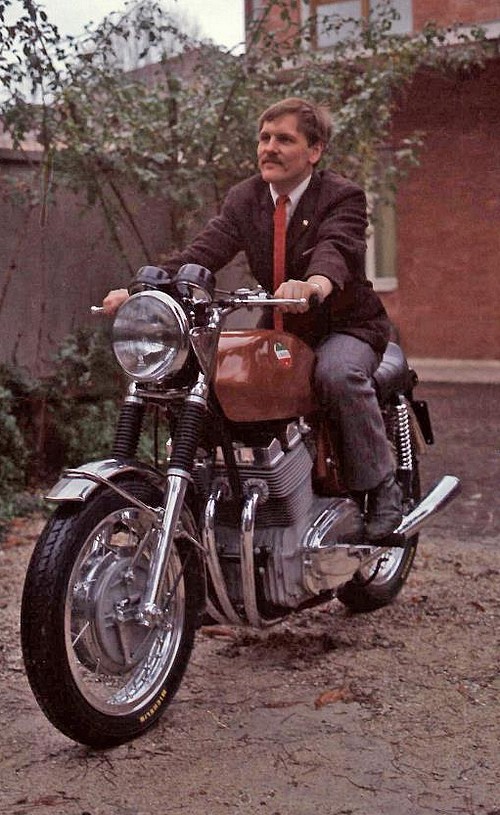
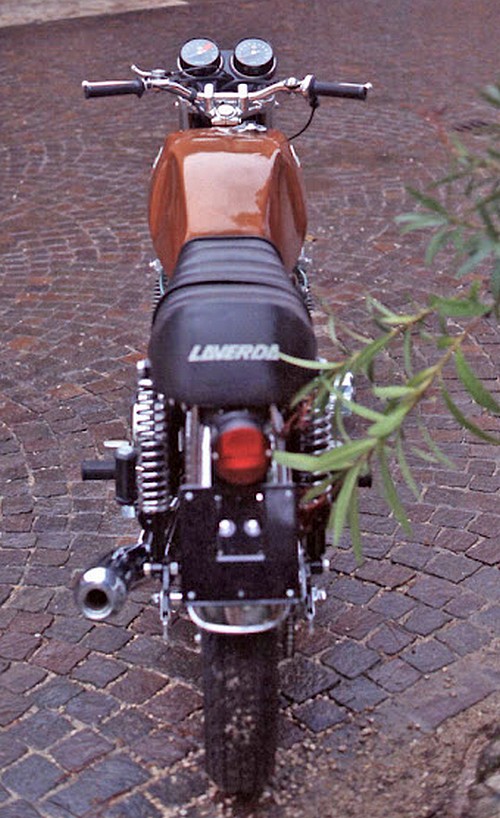
The narrowness of the 981cc triple block had been highlighted as a technological feat.
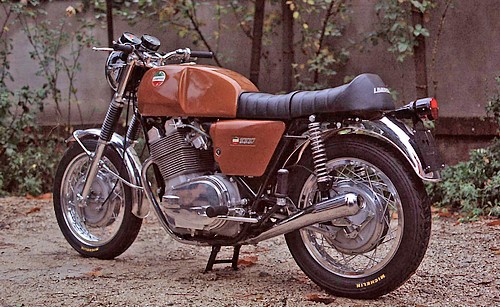
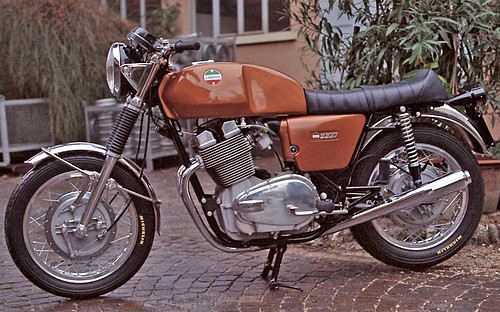
Note the alternator cover, still derived from that of the second prototype.
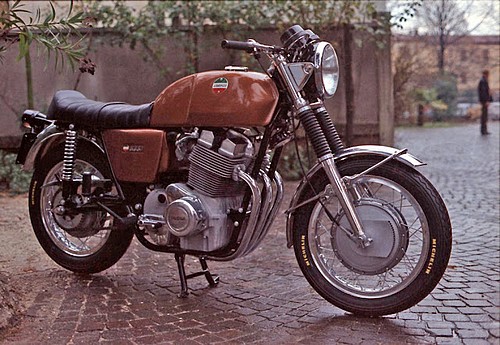
The example that would be unveiled as a preview at the Milan show in November 1971.
The provisional 1972 version
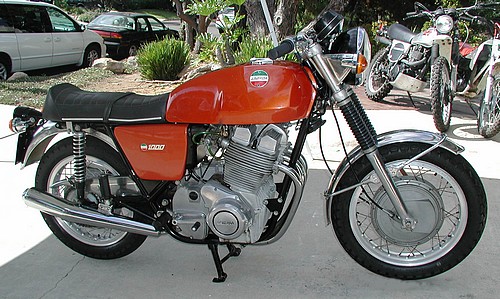
After the Milan show, testing continued actively and the bike was improved little by little. From the end of August 1972, the factory built by hand (they were still in the old factory and the production tooling for the triple was not yet available, planned to be installed in the new factory that would open in February 1973) a first batch of 43 machines, borrowing most of the equipment from the pre-production machines, notably the polyester tank, the side-mounted ignition key and the 3-into-1 exhaust.
The photo below shows one of these machines, presented to the press and to the marque's dealers by works test rider Fernando Cappellotto. The bike is still fitted with the 3-into-1 and the polyester tank, but it already has the alternator cover of the definitive version and (not visible in the photo) a key switch between the two clocks.
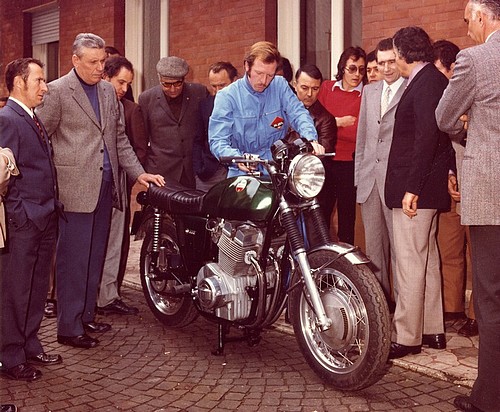
For various reasons related notably to the delay of the new factory, but also to availability problems with certain parts (polyester tanks) and homologation in some countries, these bikes were put on hold pending final decisions on the choice of equipment. In March 1972 the factory ordered steel tanks and new 3-into-2 exhausts; this equipment would be delivered in June, and all the definitive bikes would be fitted with it, including the aforementioned 50 machines.
In June 1972, as a test, the factory entered a 1000 in the International Open Class at the Steiermark Trophy in Austria. Ridden by Augusto Brettoni, before it was even on sale, hastily fitted with racing bodywork borrowed from the 750 SFC, the Laverda 1000 won this event despite formidable competition (Honda 750, BMW, British triples).
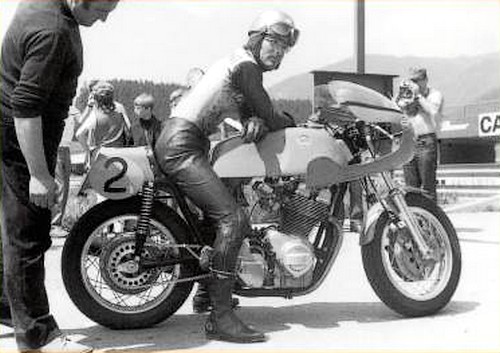
At Zeltweg before the start. Behind A. Brettoni, Nino Caretta, chief mechanic of the Laverda factory.
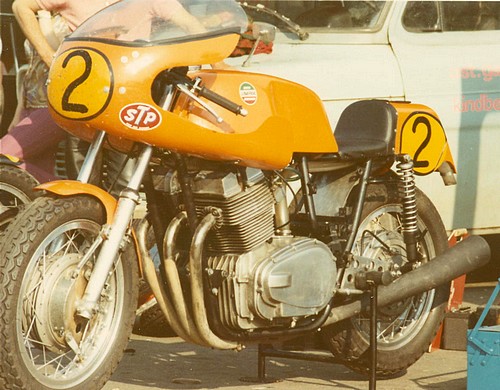
At the end of August 1972, the first production 1000 triple left the factory in its definitive version, comprising notably a large 200mm Bosch headlight (not H4), a 3-into-2 exhaust, a steel tank, Ceriani suspension and second-generation Laverda drum brakes.
This first series was clearly under-equipped with its small fork and drum brakes, and the new factory was slow to open its doors, so Laverda was in no hurry to speed up production of its 1000. In fact, barely 200 examples would be sold while awaiting a much more evolved version, which would be marketed (this time from the new factory) in 1974.
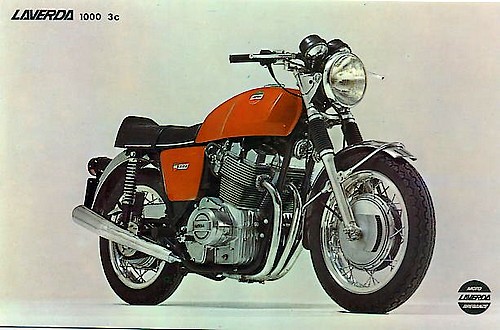
The 1000 in its definitive version.
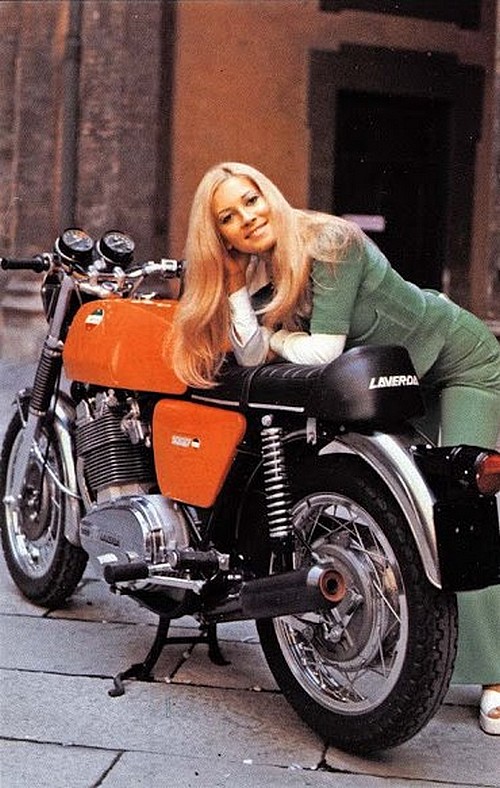
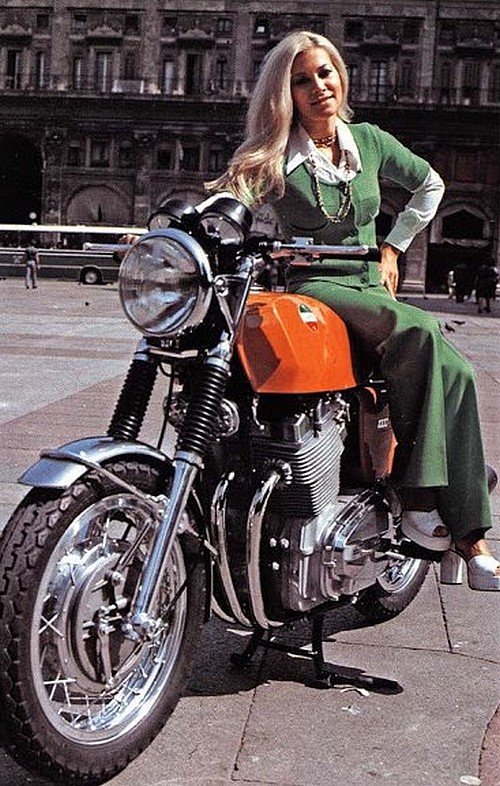
In parallel, Technical Director Luciano Zen used the transitional period of waiting for the new factory to open to modernise the machine and plan its large-scale production, which would in fact only arrive in the second half of 1973.
He also refined the concept of the race machine after Zeltweg in order to present the 1000cc at the Bol d'Or at Le Mans in September 1972. This race was decisive for the marque because, on the one hand, the Bol d'Or had a strong reputation and offered good promotional prospects, and on the other hand Laverda had finished second in the previous edition with the 750 SFC. Even though he had won at Zeltweg in June with the 1000, Augusto Brettoni insisted on racing with the 750 SFC, keen to repeat the 1971 feat, or even improve on it. The factory therefore entrusted the 1000 to riders Melody and Cash, who had been introduced to it by the British importer Slater.
In the race the bike proved fast despite very limited preparation (an almost standard engine, raised in the frame to increase ground clearance) and was among the best machines, but a gear-selection problem forced it to retire at the fifth hour.
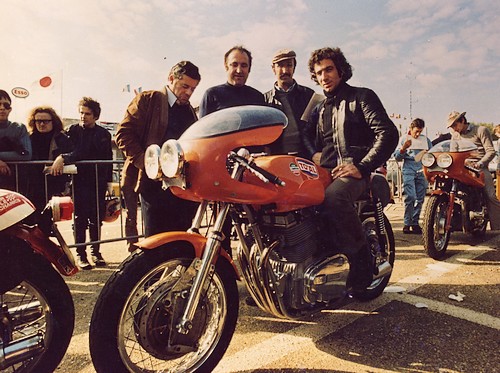
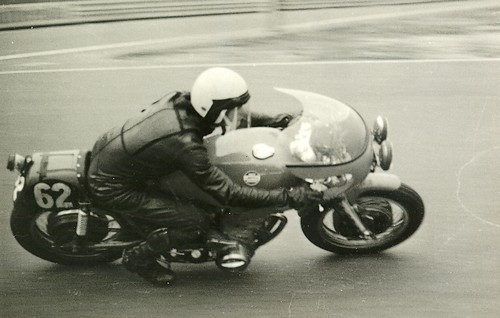
The following months were entirely devoted to the move to the new factory and to installing and setting up the production tooling, both for the 750 and for the new 1000.