Note to the reader: The information given below concerns the various types of Laverda 1000 and 1200 as a whole. The factory did, however, occasionally but fairly regularly use different parts within a single series, notably depending on supply uncertainties from subcontractors. It is therefore not unusual for bikes from a later series to have been fitted with engine or chassis parts from an earlier series, or for two bikes from the same series to differ slightly — this being in no way proof that a model is not original.
Photos subject to copyright (Laverda factory, Laverda family, G. Sperotto, JL Olive; reproduction forbidden without permission of the rights holders)
1974
As we have seen, the start of production was difficult, delayed by the time it took to open the new factory and to set up the production tooling. There was simply no room inside the old factory (already fully occupied by the 750) to produce the new triple, and without production tooling it could only be built by hand, therefore in dribs and drabs — which was indeed the case for the 200 machines of 1972.
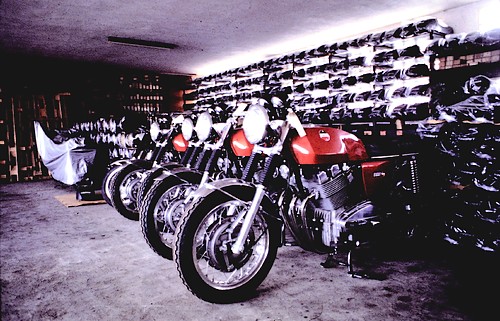
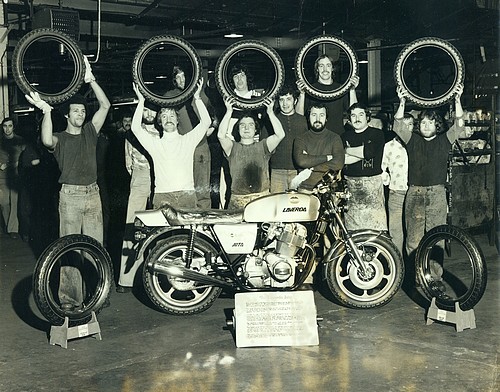
The photo below shows how cramped the premises were in 1972; these first 1000cc bikes lined up are among the first 200 with drum brakes, ready to be delivered to the very first customers.
As we have seen, Technical Director Luciano Zen was working intensively to modernise the machine and plan its large-scale production.
Once the new factory opened in 1973, it still took time to fit it out, so it was only around May that production really got under way — at full tilt! It was necessary not only to install and master the tooling, but also to catch up in order to meet demand, notably by offering a machine that was at last finished, modern and high-performing.
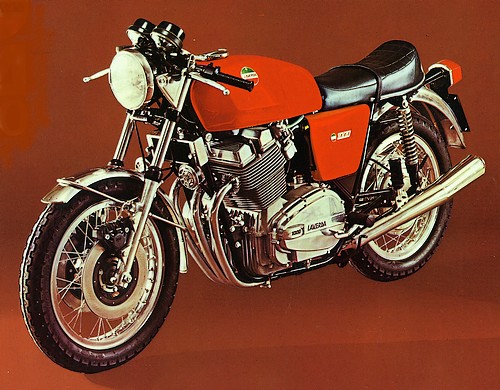
Contrasting radically with the concept of the 1971/72 1000 — a machine with an exceptional engine but improvable equipment — the 1974 version of the 1000 3C became a homogeneous bike, fitted from the outset with top-quality equipment including a very effective 38mm Ceriani fork and Brembo front disc brakes, a benchmark. The switchgear was now of Japanese origin, and during this model year the engine progressively received a few improvements: reinforced valve guides and the fitting of intake seals, modified tappet guidance, a change of type for the left crankshaft bearing, modification of the clutch, modification of the ignition, the fitting of a carburettor balance beam, different intake manifolds and consequently a modified head. At the end of the year an oil cooler was fitted, and the crankcase was modified for the first time.
The styling also evolved, with a smaller front headlight (180mm), a more graceful seat than the earlier 750 SF type, and a multi-position handlebar, set from the factory clip-on style, which reinforced the sporting look of the 3C.
The 1000 instantly became the symbol of the Italian-style superbike — racy, elegant and high-performing, also enjoying excellent stability and handling — as legendary in people's minds as the Countach was at Lamborghini at the same time, and the comparison did not stop there.
Two factors, however, compromised its success: the delay of more than two years before a finished model was marketed (in the meantime, discouraged potential customers had turned to the Japanese models, whose development was proceeding apace) and its price, very high compared with the competition owing to circumstances (the factory move, the time needed to recoup the investment).
The particular image of the Laverda 1000 nonetheless allowed it to be sold in nearly 1500 examples in the 1974 version (i.e. late 1973 and in 1974).
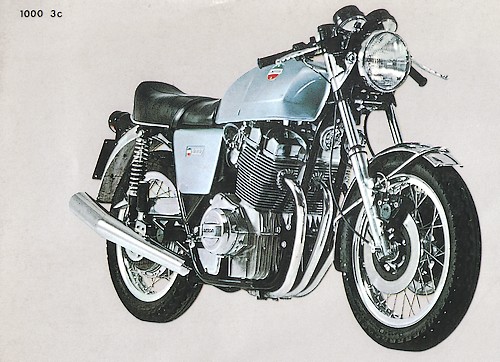
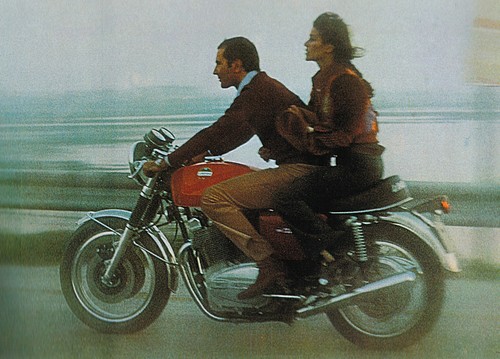
The archetype of the Italian-style sports bike.
On the competition side, Luciano Zen worked much more intensively than in 1972 and concocted a new race machine, whose engine was extensively reworked. By fitting high-compression pistons, different camshafts (lift and duration) christened 4C, a specific 3-into-1 exhaust and other improvements, power rose to 92/95 hp at 7800 rpm. The fairing abandoned the 750 SFC style for a more enveloping system to improve rider protection during long endurance races. The chassis benefited from several improvements (reinforcement, modification of the rear part of the frame, shock angle) but remained strictly based on the production machine.
This bike was entered in the Barcelona 24 Hours, where it finished 3rd, in the Truxton 400 Miles (4th) and in the Bol d'Or, where its excellent start was compromised by a heavy crash at the sixth hour. The bike could be repaired after a long pit stop and finished 13th in the hands of G. Fougeray.
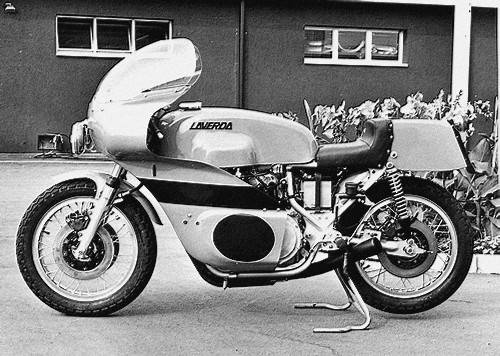
The potential of the Laverda 1000 in racing interested many teams and privateers around the world, and initiatives were seen everywhere — Austria, Italy, the USA and England, where the famous "Nessie" of Mead and Tomkinson would be born, a concentrate of new technologies built around the Laverda engine.
1975
Even though the oil cooler was fitted in 1974 at serial no. 1806, this equipment would identify the 1975 model year (which began at no. 2183). It would not, however, be the only modification for that year: significant changes to the crankcases, reinforced and given a new lubrication circuit, another modification of the ignition module, a change of front brake distributor and hoses, a new more powerful alternator (140W), of the wiring harness and rectifier unit, a change of the rear light which became rectangular, flexible mounting of the front mudguard, and a new position for the horns on the lower fork yoke.
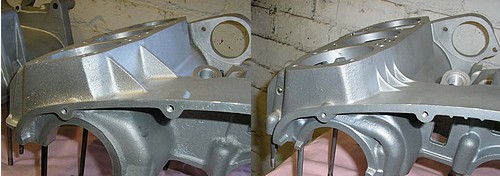
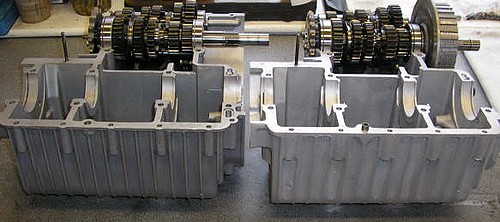
At serial no. 2483, the crankcases were considerably modified, with additional reinforcing ribs behind the cylinder block, a different oil passage at the front left corner of the engine, and a generally better casting finish.
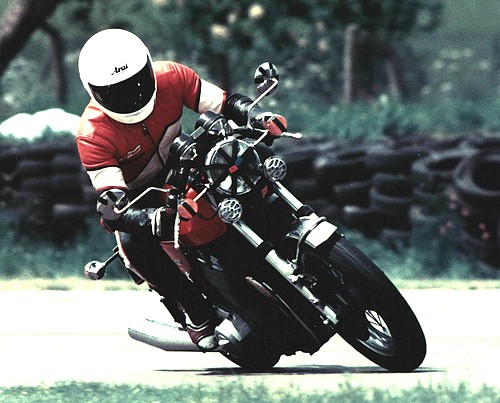
The factory was increasingly asked by privateers to adapt the 1974 racing parts (what would be called the "4C kit") onto road machines and, in fact, some 3Cs were fitted this way either by the dealers, but most often by the factory directly. In England, the local importer (Slater) did the same but had the idea of turning it into a marketing move by naming this type of bike "3CE" (3C England). The bike thus equipped would be formidable in local races.
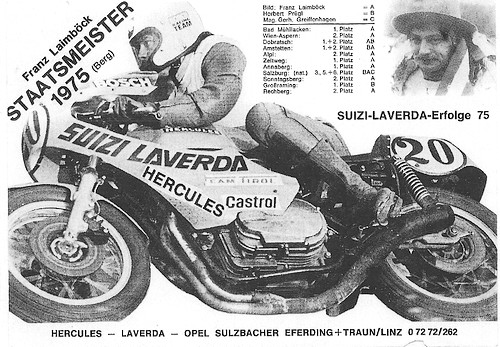
Other preparations of the same type took place with other importers, as was the case with Werner Sulzbacher in Austria who, with the help of his engineer/rider Franz Laimböck, won the National Championship.
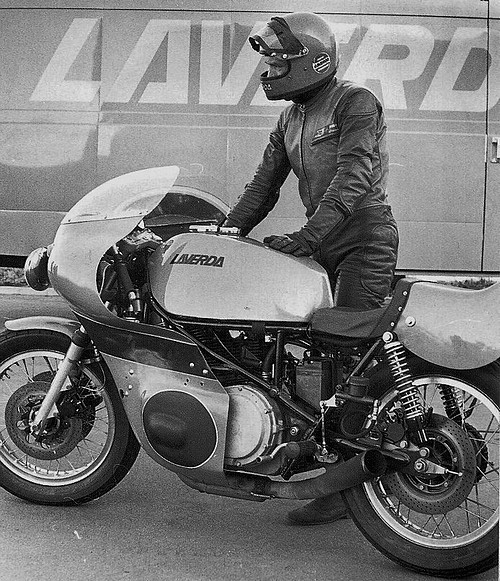
But the main innovation of 1975 would undoubtedly concern the development of the racing 1000: the 1974 machine had good engine potential (the 1974 preparation is, moreover, still a benchmark for the Breganze triples) but it remained relatively heavy. Luciano Zen then designed a perimeter frame in chrome-molybdenum steel, christened "spaceframe" and weighing only 13.5 kg. This frame also had the advantage of being very rigid, ensuring effective handling, the Laverda then often being the fastest machine in racing at the places most difficult for chassis and suspension, such as the Chemin aux Boeufs corner at Le Mans.
The spaceframe prototype used a 3-into-3 exhaust, with two exhausts on one side and one on the other, but they very quickly reverted to the 3-into-1.
On the engine side, Luciano Zen started from the base of the 1974 engine, adopting just a few technical modifications depending on the circuit, such as new very exclusive camshafts (christened 7C) for the fastest tracks. In maximum development form, power rose to a little over 100 hp (101 hp at 8000 rpm). To contain this power, the primary drive was now made up of a quadruplex chain and a duplex chain for the secondary.
The Spaceframe achieved remarkable results during the 1975 season with a 2nd and 2nd place at the Spa-Francorchamps 24 Hours, 3rd at the Mugello 1000 km, and it long held 2nd place at the Barcelona 24 Hours before falling victim to a collision and finally finishing (after a long repair) in 6th position in the hands of Georges Fougeray.
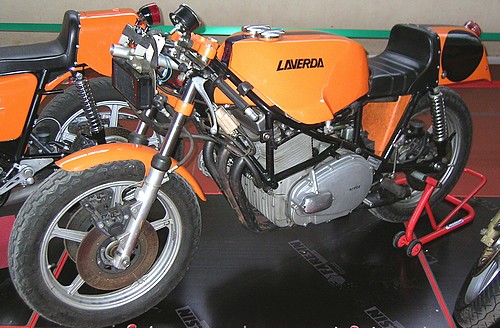
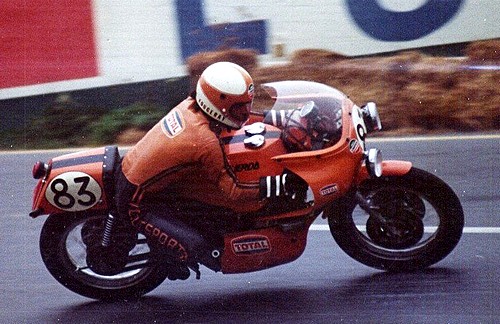
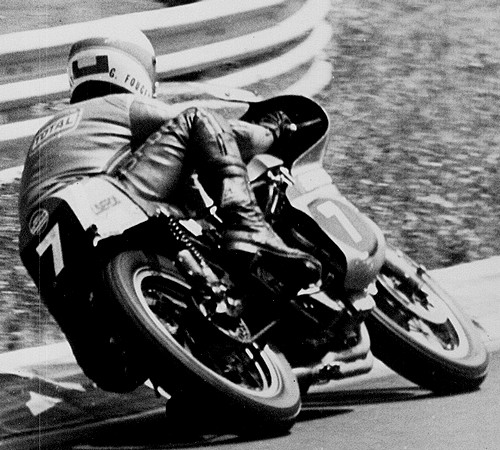
At the Bol d'Or, Luciano Zen tested a spaceframe with an engine no longer timed at 180° but conventionally at 120°, after fitting a new, more resistant type of crankshaft bearing. This bike was ridden by Georges Fougeray and Marco Lucchinelli but was a disappointment engine-wise. Moreover, after a head-gasket problem and a puncture, the vibrations caused by the 120° timing created a multitude of small failures that ended up delaying the machine too much, and it was voluntarily withdrawn. The second bike (Gallina/Cereghini), timed at 180°, ran like clockwork until the twelfth hour, when its ignition gave up the ghost, and the delay caused by push-starting over almost the entire course became insurmountable, so the second machine was also withdrawn from the race.
1975 would be the last year of development of the racing 1000, Laverda now aiming for a much more radical machine, which would be the 1000 V6 planned for 1978.
1976
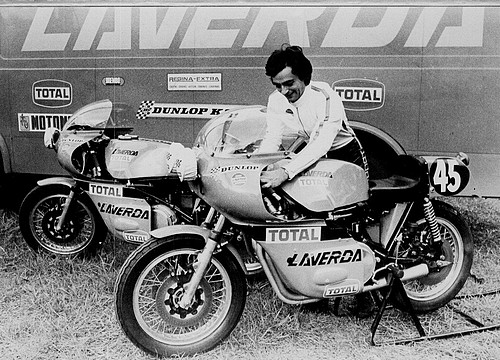
The 1000 would benefit from significant changes in 1976. By adopting alloy wheels (with spokes/spurs) and a seat hump, the 3C became the 3CL, with a much more modern design. During the year, the head was completely redesigned and now adopted all-aluminium combustion chambers (previously cast-iron caps). In France and Switzerland, to comply with the new noise standards, the 3CL received tamer camshafts (A12), a more muffled air-filter box, quieter exhausts — the engine lost nearly 10 hp…
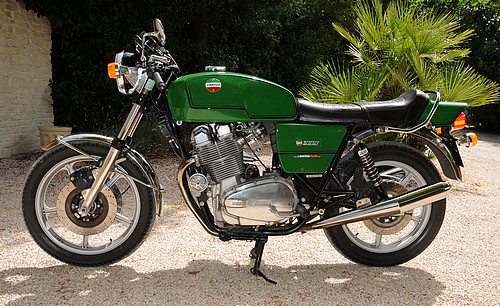
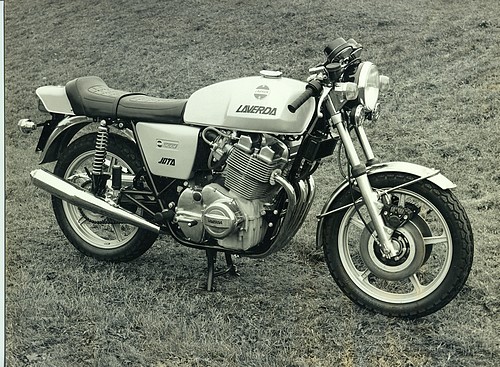
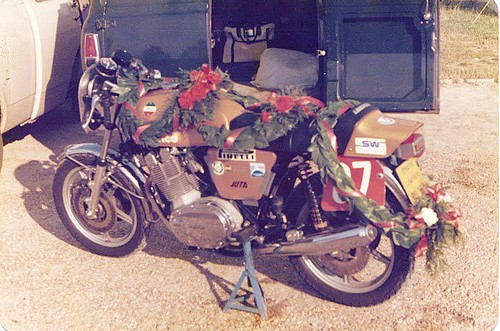
In England, on the other hand, the English importer wished to offer its customers a sporting model using, like the 1975 3CE, the factory racing parts. He managed to convince Massimo Laverda and proposed the name of a Spanish dance in three beats (Jota) for this new model. The factory supplied the bikes fitted with the special parts, and the importer brought the expertise of an English exhaust specialist for a specific system. The Laverda Jota was born, available in metallic grey, and it quickly became a legendary bike, on the one hand because it was now the fastest production motorcycle in the world (over 140 mph) and on the other hand because in 1976, but also in 1977, 1978 and 1980, it would win the English production championship (Avon Production Championship) ahead of all the competing bikes, above all Japanese ones.
1977
1977 would be the year production of the 3C ended. Even though it continued to be distributed, customers preferred the 3CL and 3C sales became negligible.
The 3CL continued its career without much change from the 1976 model, but the Jota really took off in England (offered there in metallic gold), where it won the production championship for the second consecutive time.
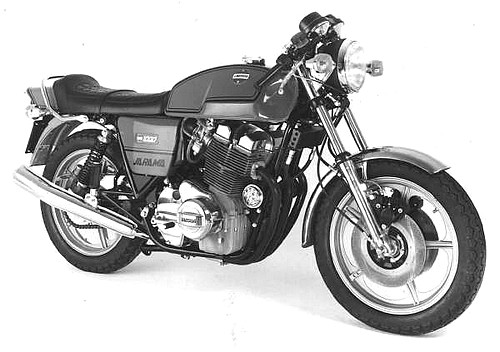
A special series of 3CL, developed by the English importer, was sent to the USA with a left-side gear-shift linkage and engine settings allowing it to pass the anti-pollution standards. This model, called "Jarama", sold poorly (its engine was considerably detuned compared with the Jota); many Jaramas were brought back to England, where they were sold 1000 pounds less than the 3CL. This time the sale was a success, customers seeing a fine opportunity to buy a machine cheaply that could then very easily become a Jota by fitting the racing parts.
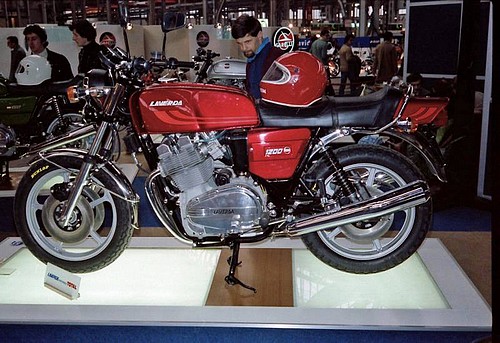
But 1977 would also be the year a new Laverda triple was released, the 1200, presented at the Milan show. Very close to the 1000 3CL, its engine was fitted with three 80mm pistons (instead of 75 for the 1000), thus raising the capacity to 1116cc. The factory made it above all a touring machine, full of torque and more docile than the 1000. The frame was identical to the 1000 except for the position of the upper rear shock mounts and a Marzocchi 38 fork (following an inability of Ceriani — which was in difficulty — to meet demand), solutions that would also be adopted on the 1000 after it had a transitional frame with both types of shock mount, angled or more vertical.
1978
While the 3CL continued to be marketed, still without major modification apart from the Marzocchi fork and the angled rear shocks, the 1200 was marketed from the start of 1978.
The English importer would try to have it prepared like the Jota with the factory racing parts, which would give the "Mirage", but the head designed for the 1000 struggled to compensate for the big bore. While the Mirage was very torquey, it had neither the liveliness nor even the performance of the Jota.
1979 and 1980
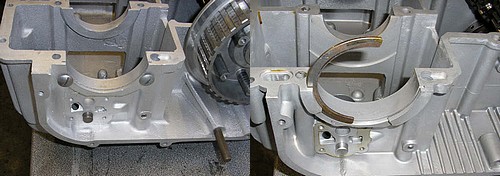
Still grappling with homologation standards, notably regarding noise, the factory made a decision in 1979 that was heavy with consequences. A bearing manufacturer offered it a new model supposed to reduce running noise, and the factory fitted them as crankshaft bearings. Again to reduce noise, new valve springs were also fitted. Both the new bearings and the springs would cause problems very quickly, the two breaking with disconcerting ease. The factory reacted quickly, published the list of machines concerned (about a thousand 1000s and 1200s), sent technicians to the importers to help replace the defective bearings and springs under warranty, but this affair did the company enormous harm.
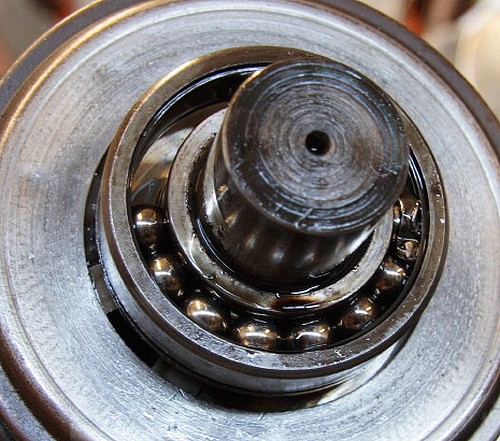
A bearing from the bad batch of 1979 and 1980.
The Jota nonetheless continued to shine, winning the production championships in England and Sweden. During the year, it was offered with a fork-top fairing.
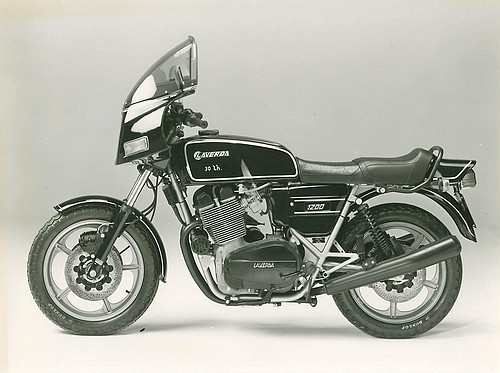
Note the release in 1979 of the 1200 "30th Anniversary" version, a variant of the 1200 with an overall black-and-gold decoration, produced in 200 examples, celebrating the marque's 30th anniversary. Each 30th customer received a personal letter from Massimo Laverda and a medal. This version quickly sold successfully, but was unfortunately affected by the bad crankshaft-bearing problems.
1981
Following a deep redesign of the 1000 at the end of 1980, the factory brought out a final version of its 1000 Jota (end of 3CL production) and its 180° 1200, at serial no. 7237 for the 1000s and 3063 for the 1200s. The ignition moved to the left, the alternator gained power (250W), the head was redesigned (the shift moving to the left) as were the primary drive and the clutch (to reduce noise). A new fork-top fairing was fitted, and the bike was offered only in orange with a metallic grey frame. The French and Swiss versions would be fitted with the detuned engine with A12 camshafts and flat pistons, which was heresy in the motorcycling world of the early 1980s.
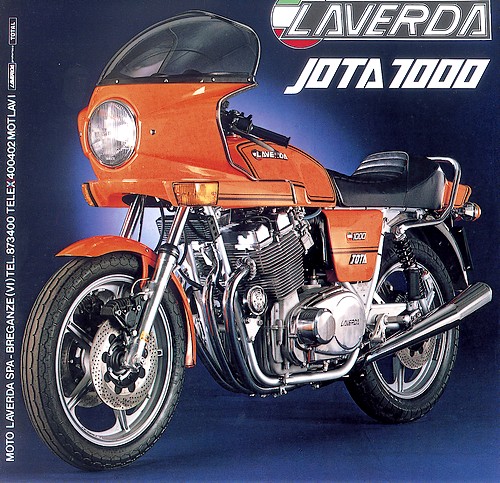
The 1200 benefited from these modifications and was released in 1981 as the 1200 TS, a very grand-touring version, whose main market would be Spain following protectionist measures making it very difficult to import a Japanese bike. This TS would be the last Laverda 1200.
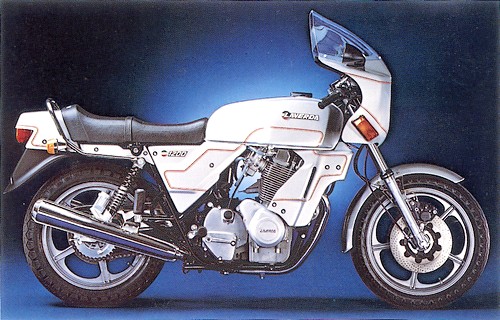
This new version brought about a spectacular (but temporary) increase in sales, especially after the unfortunate 1979 episode.
During 1981, the factory also worked on a 120° version of the triple engine. The aim was to make the bike more docile, since the exclusive character of the 180° certainly had its devotees but was increasingly singular in the more sanitised motorcycle world of the 1980s.
At the end of 1981, this new engine appeared and would equip the Jota 120, the first of the line of Laverda 1000 120° that is the subject of the next chapter.
1000cc production
| Year | Production (official 19/06/1991) | Production (Laverdamania est.) | Notes |
|---|---|---|---|
| 1972/73 | 670 | 580 | Approx. 240 3C/1. The 1974 model is produced from August 1973. |
| 1974 | 780 | 820 | |
| 1975 | 830 | 700 | |
| 1976 | 1150 | 1350 | |
| 1977 | 1000 | 700 | |
| 1978 | 860 | 350 | |
| 1979 | 750 | 450 | |
| 1980 | 650 | 120 | First series 2: no. 7237 |
| 1981 | 490 | 900 | |
| 1982 | 200 | 260 | Last 180°: no. 8159 |
| 1983 | 120 | / |
| 180° series 1 | 6236 (+ at least one model outside normal numbering) |
|---|---|
| 180° series 2 | 921 |
| Total 180° | 7157 |
1200cc production
| Year | Production (Laverdamania est.) | Notes |
|---|---|---|
| 1977 | 210 | |
| 1978 | 640 | |
| 1979 | 500 (+ 50 to 80 outside normal numbering) | |
| 1980 | 450 | First series 2: no. 3063 |
| 1981 | 500 | |
| 1982 | 300 | |
| Total | 2600 | (+ 50 to 80 outside normal numbering) |