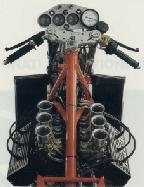
How can you talk about Laverda without mentioning the 1000 V6, the only motorcycle ever designed with a V6 engine?
The project was born in 1976, with the intention of creating, once and for all, the superbike that could win the greatest endurance races against the many Japanese factories — and give rise, why not, to a unique and revolutionary road model.
The targets were set very high from the outset, no doubt a little too high for the factory's financial resources… But who could blame them for taking on this challenge and leaving behind one of the most fabulous motorcycles of all time?
The specification called for a stressed-member V6 engine mounted longitudinally, able to dominate the entire competition in power and top end, and a chassis capable both of offering modern geometry and suspension and of staying rigid despite the engine's power.
The Laverda brothers already had someone in mind to handle the engine design: engineer Alfieri, who had worked with Lamborghini and, above all, was the designer of the Maserati V6s, was the ideal man. He was therefore entrusted with building the Laverda V6.
Fitting such an engine into a motorcycle was not without its difficulties. The first technical problem concerned the engine's position: the longitudinal layout produced a very strong overturning torque, tending to lay the bike over to the right under acceleration.
Alfieri managed to solve this problem entirely by creating a counter-torque, notably through the reversed rotation of the alternator. Building the frame around this engine was no easy matter: an enveloping "spaceframe" type was too bulky and heavy, and it also prevented quick access to the mechanicals.
They therefore arrived at the stressed-member solution, which reduced the bulk of the backbone.
Other difficulties could not be solved satisfactorily: the cantilever suspension of the first prototype placed too much stress on the shaft drive. They therefore reverted to the classic twin-shock suspension.
Little by little the problems were solved, and the 1000 V6 could make its first tests in near-definitive form, the goal being to line it up at the 1978 Bol d'Or.
However, because of the monstrous budget this machine required, the factory could not carry out all the desired testing and modifications.
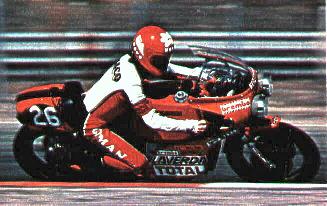
It was in these conditions that the V6 arrived at the Paul Ricard circuit for the 1978 Bol d'Or.
The surprise in the paddock was great — nobody was really expecting the V6, which was then regarded as a show project. The surprise was just as great in practice when the V6 was timed at 283 km/h, some 38 km/h faster than the best of the works Hondas!
But it was also clear that the machine was slow through the corners, having lacked the time and resources needed to improve the chassis and its geometry.
It was in this context that the 1000 V6 raced the Bol d'Or in the hands of Perugini and Cereghini, its top-speed advantage compromised by the bike's lack of handling. The race ended after seven and a half hours with a broken drive shaft (one of the few parts not of Laverda's own making!).
Sadly, the V6 adventure ended there: worried by the arms race, the FIM banned motorcycles with more than four cylinders from the following year.
It is a shame that this motorcycle could never receive the improvements it needed, and remarkable that the Laverda factory attempted to see through such a gigantic project.
It is projects like this that permanently forge the aura of the great marques; the Laverda V6 has become a legendary motorcycle that everyone wants to see and hear roar.
Like other bikes that also never achieved results matching their technology (the Honda NSR, for example), it has become one of the last sacred monsters of the motorcycling world.